
The Power of Understanding AI vs RPA: Why Pricing Models Matter
AI vs RPA represents a critical decision point for organizations evaluating automation strategies, moving from traditional per-bot licensing models to usage-driven AI automation platform costs. Operations teams implementing professional automation solutions are fundamentally choosing between different financial structures including RPA’s heavy upfront licenses plus maintenance versus AI automation software’s ongoing variable expenses for API calls, transcription, and orchestration. Advanced AI consulting now helps organizations navigate pricing complexity that once obscured true total cost of ownership, enabling teams to model ROI accurately while understanding how different automation approaches impact both budget allocation and operational scalability.
The data supporting strategic pricing analysis continues to strengthen across automation functions. According to McKinsey research, 64 percent of executives report that AI is enabling innovation at their firms though enterprise-level EBIT impact is slower to show, demonstrating widespread adoption with financial returns requiring careful measurement and workflow integration. Deloitte data shows organizations that moved beyond pilots of intelligent automation report average cost reductions around 30 percent from automation and workflow redesign, validating substantial ROI when implementations extend beyond technology deployment to process transformation. OpenAI and major LLM providers publish transparent per-token or per-minute pricing for inference and transcription creating measurable variable costs contrasting with RPA’s fixed licensing structures.
Why AI vs RPA Pricing Matters for Budget Planning
Understanding AI automation platform versus RPA cost structures transforms how organizations approach automation investments, technology selection, and value realization. Budget allocation decisions that once created bottlenecks through incorrect financial modeling, hidden costs, or inflexible commitments can now be executed strategically through AI consulting relationships that clarify total cost of ownership. From modeling RPA as heavy upfront license plus integration and maintenance to treating AI automation software as ongoing variable costs for API calls and monitoring, appropriate financial analysis delivers realistic forecasting that strengthens both operational planning and executive confidence.
For finance and operations leaders evaluating AI vs RPA strategies, the pricing differences manifest in five critical ways:
- License vs Usage Cost Structures: RPA historically sells per-bot licenses, enterprise suites, and professional services creating upfront commitments, while AI automation platform costs are usage-driven based on model selection, token consumption, and minutes for text-to-speech and transcription, with Blueprint showing average organizational RPA spend around mid-hundreds of thousands annually requiring different budget planning approaches.
- Infrastructure and Orchestration: Traditional RPA program costs include licenses, infrastructure, orchestration platforms, and professional services according to Blueprint surveys, while AI automation software requires monitoring and governance infrastructure plus API integration creating different architectural expense profiles requiring careful comparison beyond pure licensing or usage fees.
- Variable vs Fixed Expense Profiles: AI vs RPA creates different cash flow patterns with RPA requiring heavy upfront license plus integration and maintenance creating fixed annual commitments, while generative voice AI incurs ongoing variable costs including API calls, text-to-speech, and transcription plus monitoring and governance scaling with actual usage volume.
- Scaling Economics: Small RPA pilots appear cheap but full programs become materially expensive when scaled according to Blueprint reporting average substantial annual spends, while AI automation platform variable costs scale proportionally with volume enabling more predictable cost modeling as implementations expand though requiring careful usage monitoring and optimization.
- ROI Achievement: Deloitte shows organizations moving past pilots report approximately 30 percent cost reductions from process redesign plus automation providing optimistic upper bound for ROI modeling, though McKinsey notes enterprise-level EBIT impact slower to show and Tom’s Hardware indicates notable share of AI pilots don’t yet show direct P&L impact without operational changes requiring workflow integration for financial returns.
AI vs RPA is not just about technology capabilities; it is about understanding pricing models enabling accurate total cost of ownership analysis, appropriate budget allocation, and realistic ROI forecasting that supports sustainable automation programs rather than creating financial surprises or executive disappointment.

Key Considerations When Evaluating AI Automation Software vs RPA Costs
Selecting the right approach for AI vs RPA requires careful alignment between financial structures and operational requirements. The most successful AI automation platform implementations are built on a foundation of transparency, realistic cost modeling, and measurable impact on critical metrics enabling accurate ROI calculation beyond simplistic cost-per-bot or cost-per-call comparisons.
Below are the core factors that should guide every AI vs RPA pricing decision:
- Total Cost of Ownership Analysis: Every automation initiative must calculate comprehensive costs including licenses or usage fees, infrastructure and orchestration, integration and professional services, monitoring and governance, change management, and ongoing maintenance. For RPA, treat as heavy upfront license plus integration and maintenance. For AI automation software, model ongoing variable costs for API calls, text-to-speech, and transcription plus monitoring and governance overhead.
- Usage Pattern Modeling: Effective AI automation platform requires understanding token consumption, inference volumes, transcription minutes, and text-to-speech usage creating variable costs that scale with actual automation activity. OpenAI and major providers publish per-token or per-minute pricing enabling measurable cost forecasting when usage patterns are documented through pilots validating assumptions before full deployment.
- Process Redesign Requirements: Both AI vs RPA approaches require workflow integration for financial returns, with Tom’s Hardware showing notable share of AI pilots don’t show direct P&L impact without operational changes. Include change management, process mapping, stakeholder alignment, and continuous optimization expenses beyond pure technology costs when calculating total investment and expected ROI timelines.
- Scaling Cost Trajectory: Blueprint surveys show RPA programs can reach mid-hundreds of thousands annually when scaled with small pilots appearing cheap but full implementations becoming materially expensive. AI automation software variable costs scale proportionally with volume requiring sensitivity modeling understanding how growth impacts budget, though Deloitte shows 30 percent cost reductions possible offsetting variable expense increases.
- Asset Ownership and Portability: Contract terms affect long-run costs through vendor lock-in or flexibility. Ensure ownership of prompts, flows, and evaluation sets for AI automation platform implementations, and confirm bot export capabilities for RPA, preventing situations where switching costs become prohibitive as McKinsey shows 64 percent report AI enabling innovation requiring architectural flexibility supporting evolving requirements.
- ROI Timeline and P&L Impact: McKinsey notes enterprise-level EBIT impact slower to show despite 64 percent reporting innovation, while Deloitte indicates 30 percent cost reductions achievable when moving beyond pilots with process redesign. Model realistic timelines for financial returns understanding that governance, workflow integration, and operational changes matter as much as technology selection for proving P&L impact justifying continued investment.
Choosing AI consulting partners who understand these financial complexities ensures your investment delivers sustainable improvements rather than creating budget surprises, inflexible commitments, or governance gaps that limit future flexibility when automation strategies or technology requirements evolve.
Understanding AI vs RPA KPIs: What to Measure for ROI
Before launching any automation initiative, organizations must thoroughly define success metrics enabling objective cost-benefit analysis and ongoing performance monitoring. Key performance indicators provide the measurement framework distinguishing valuable implementations from expensive failures creating executive skepticism about automation investments. When operations and finance teams establish KPIs in advance, they align stakeholders around clear targets, enable data-driven optimization, and build business cases justifying continued investment through demonstrated value.
- Average Handle Time (AHT): Target reduction in call or case duration understanding how automation affects wrap-up work, measuring efficiency gains enabling capacity release that offsets technology costs through reduced staffing requirements or absorbed volume growth without proportional hiring.
- First-Call Resolution (FCR): Ensure automation doesn’t reduce FCR through premature escalation or poor routing, as maintaining single-touch resolution protects customer satisfaction even when AI vs RPA handles initial interaction requiring seamless handoff when human expertise becomes necessary preventing callback volume increases.
- Escalation Rate: Track percent of interactions passed to humans with detailed reasons for escalation, analyzing patterns to identify automation gaps, confidence threshold tuning opportunities, and training needs ensuring appropriate balance between containment and quality affecting overall cost structure.
- SLA Breach Count and Remediation: Deploy automated alerts for service level threshold approaches and establish rollback thresholds triggering reversion when automation performance degrades, protecting customer commitments through proactive monitoring as Deloitte shows 30 percent cost reductions achievable but requiring operational discipline.
- Cost Per Contact or Transaction: Estimate agent or operator time saved versus AI automation platform or RPA vendor costs including integration, monitoring, training, and governance overhead, with Blueprint showing RPA programs reaching mid-hundreds of thousands annually requiring sensitivity modeling as small changes in volumes have outsized financial impact.
- Process Redesign Value: Measure improvements from workflow transformation beyond pure technology deployment, as Tom’s Hardware notes notable share of AI pilots don’t show P&L impact without operational changes, with Deloitte indicating 30 percent cost reductions come from automation plus redesign requiring holistic measurement.
Pro Tip: Include one-time integration costs, change management expenses, monitoring infrastructure, and retraining investments in total cost calculations. Don’t forget human costs to review and label failed or ambiguous cases, as governance and workflow redesign matter as much as the model or bot according to industry reviews showing many pilots fail to move P&L needle without operational integration.
Common Pitfalls in AI vs RPA Cost Analysis
AI automation software and RPA promise efficiency and cost reduction, but poor financial modeling and inadequate planning can create budget overruns instead of savings. Many organizations make avoidable mistakes during evaluation that delay value realization and erode both financial and leadership confidence. To discover proven methodologies tailored for your automation requirements and cost optimization, explore our AI Workflow Automation Services page for detailed AI consulting frameworks and real-world implementation guidance.
- Vendor Promises Large Savings Without Evidence: Some AI automation platform or RPA proposals claim unrealistic cost reductions without validation. Pilot with realistic workflow mixes measuring actual efficiency gains and cost savings rather than accepting theoretical containment or productivity percentages, as Deloitte shows 30 percent achievable but requiring process redesign beyond technology.
- Hidden Infrastructure Costs: Organizations overlooking orchestration, monitoring, governance, and integration expenses discover budget surprises. Blueprint shows RPA programs include licenses, infrastructure, orchestration, and professional services reaching substantial annual totals, while AI automation software requires monitoring and governance infrastructure beyond pure API usage costs requiring comprehensive TCO analysis.
- No Rollback or Kill Switch: Launching automation without reversion capability creates risk when implementations degrade operations or customer experience. Make contractual kill switch and automatic reversion requirements preventing situations where failed automation continues consuming budget without delivering value as Tom’s Hardware shows notable share don’t show P&L impact.
- Ignoring Process Redesign Expenses: Teams treating automation as pure technology deployment face disappointment. Include change management, workflow mapping, stakeholder training, and continuous optimization costs in total investment, as industry reviews show governance and operational changes matter as much as models or bots for achieving McKinsey’s reported innovation and Deloitte’s 30 percent cost reductions.
- Asset Lock-in Without Portability: Contracts lacking export provisions create switching costs preventing competitive negotiations and future flexibility. Add exportability clauses for prompts, flows, evaluation sets, or bots ensuring you can change vendors or bring automation in-house without losing operational capability or starting from scratch after substantial investment.
- Insufficient Usage Monitoring: AI automation platform variable costs require tracking token consumption, API calls, and minutes used. Without monitoring, usage can scale unpredictably creating budget overruns, as OpenAI and providers charge per-token or per-minute requiring governance preventing runaway costs from inefficient implementations or unexpected volume spikes.
- Over-Optimistic ROI Timelines: McKinsey notes enterprise-level EBIT impact slower to show despite 64 percent reporting innovation. Model realistic timelines for P&L impact understanding that financial returns require workflow integration and operational discipline beyond just deploying technology, preventing executive disappointment when immediate savings don’t materialize.

Evaluating AI Automation Platform vs RPA ROI
Quantifying the benefits of AI vs RPA helps secure executive buy-in and refine future investments in automation technology. Measuring ROI goes beyond simple efficiency metrics; it captures gains in cost reduction, capacity release, quality improvement, and strategic capability. Without clear financial modeling during evaluation, automation projects risk becoming unclear implementations that fail to justify ongoing operational expenses and licensing or usage costs.
Key considerations for financial analysis include:
- License vs Usage Cost Modeling: RPA requires modeling heavy upfront license plus integration and maintenance creating fixed commitments according to Blueprint showing mid-hundreds of thousands annually for programs. AI automation software requires modeling ongoing variable costs for API calls, text-to-speech, and transcription plus monitoring and governance according to OpenAI pricing, with different cash flow implications affecting budget planning and approval processes.
- Process Redesign Value Capture: Deloitte shows organizations moving beyond pilots report approximately 30 percent cost reductions from process redesign plus automation, providing optimistic upper bound for ROI modeling when workflow transformation accompanies technology deployment. Use as ceiling not guarantee, requiring validation through pilots before committing to enterprise-wide investments based on theoretical savings.
- Enterprise EBIT Impact Timeline: McKinsey indicates 64 percent of executives report AI enabling innovation though enterprise-level EBIT impact is slower to show, suggesting delayed financial returns requiring patient capital and realistic timeline expectations. Tom’s Hardware notes notable share of AI pilots don’t yet show direct P&L impact without operational changes, underscoring that technology alone insufficient for financial results.
- Scaling Economics and Sensitivity: Small pilots appear cheap but Blueprint shows full RPA programs become materially expensive when scaled requiring sensitivity modeling. For AI automation platform, variable costs scale with volume requiring usage forecasting and optimization, with Deloitte’s 30 percent cost reduction potential offsetting expense growth when implementations achieve operational efficiency targets through disciplined execution.
- Total Cost of Ownership: Include one-time integration expenses, change management costs, monitoring infrastructure, governance overhead, retraining investments, and human costs for reviewing failed or ambiguous cases. Both AI vs RPA require comprehensive TCO analysis beyond simplistic license or usage comparisons, as industry reviews show many implementations underestimate operational expenses beyond pure technology costs.
- Innovation Value Beyond Cost: McKinsey shows 64 percent report AI enabling innovation suggesting strategic value beyond pure cost reduction including new capabilities, enhanced customer experience, and competitive differentiation. While EBIT impact slower to show, innovation value may justify investment even when immediate cost savings don’t materialize, requiring balanced scorecard approach to ROI calculation.
McKinsey shows 64 percent report AI enabling innovation though EBIT impact slower. Deloitte indicates 30 percent cost reductions achievable from automation plus redesign. Blueprint surveys show RPA programs reach mid-hundreds of thousands annually. OpenAI publishes per-token and per-minute pricing creating measurable variable costs. When every AI automation platform and RPA implementation includes comprehensive TCO analysis covering licenses or usage, infrastructure, integration, monitoring, governance, and process redesign costs, every pilot validates actual performance and ROI under real conditions before enterprise commitments, and every quarterly review assesses financial returns against realistic benchmarks, organizations build sustainable automation programs that deliver cost reduction and innovation value justifying continued investment rather than creating budget surprises or executive skepticism.
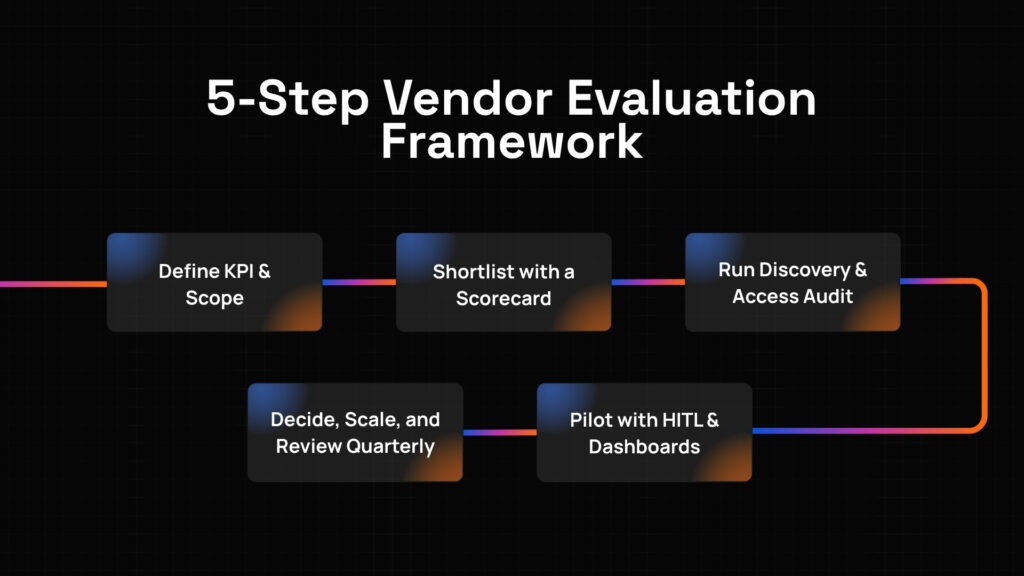
5-Step Vendor Framework for AI vs RPA Cost Analysis
Selecting an AI automation software or RPA vendor should follow a disciplined, structured process that aligns with your organization’s financial goals while accounting for both immediate costs and long-term total cost of ownership. Instead of focusing solely on lowest initial price or impressive ROI claims, evaluation should weigh how well different pricing models support sustainable automation programs with measurable returns.
1. Define KPI & Scope
Start by identifying specific measurable outcomes with narrow scope enabling quick value validation. Defining concrete targets helps align all stakeholders including operations leadership, finance departments, IT teams, and process owners. Your goal might be cutting AHT by 12 percent for billing calls while keeping FCR steady, reducing cost per contact, or improving process throughput, but it must be quantifiable with clear financial impact calculation.
Example: A telecommunications company defined its KPI as “cutting average handle time by 12 percent for billing calls while keeping first-call resolution at or above baseline within 90 days, targeting $200,000 annual savings from capacity release.” This metric guided every AI vs RPA discussion, shaped pilot design with clear financial benchmarks, and became the success measurement. Pilot on 1 call type validating costs and returns.
Pro Tip: Document one to three primary operational outcomes with explicit financial impact before requesting proposals. Focus on measurable efficiency gains tied to cost savings through capacity release or volume absorption, and define specific percentage improvement targets with dollar value enabling objective ROI calculation during pilot evaluation beyond vendor claims.
2. Shortlist with a Scorecard
Once objectives are clear, move to structured vendor comparison using a weighted scorecard evaluating AI automation platform and RPA providers. This tool allows teams to quantify how well each approach aligns with priorities including integration depth, HITL design, observability capabilities, security governance, and critically pricing transparency with total cost of ownership clarity. Score integration depth, HITL, observability, security, and pricing clarity 0 to 5.
Example: One enterprise assigned 20 percent weight to integration depth with existing systems, 15 percent to HITL and escalation design, 15 percent to observability including traces and dashboards, 15 percent to security and governance, 20 percent to pricing transparency including TCO analysis, 10 percent to delivery and enablement, and 5 percent to exit portability. Weight observability and HITL more for voice, weight pricing transparency more for enterprise-wide programs.
Pro Tip: Turn evaluation criteria into numeric scoring so decisions remain defendable beyond subjective cost impressions. Weight pricing transparency and TCO analysis appropriately given Blueprint showing RPA programs reach mid-hundreds of thousands and OpenAI showing variable AI costs requiring different budget planning. Have multiple stakeholders from operations, finance, and IT score vendors independently before group discussion to reduce bias.
3. Run Discovery & Access Audit
Before contracts are signed, a structured discovery phase maps telephony or system platforms, workflow integration requirements, data access needs, and infrastructure dependencies documenting every cost driver. During this phase, teams validate integration complexity affecting professional services costs, surface infrastructure needs affecting orchestration expenses, and confirm monitoring requirements affecting ongoing operational costs. Get access matrix and pricing assumptions sheet.
Example: A financial services company conducted discovery for AI vs RPA automation, revealing their legacy systems lacked modern APIs requiring custom middleware affecting integration costs, their monitoring infrastructure needed expansion for governance affecting operational expenses, their workflow documentation was incomplete requiring process mapping professional services, and their security requirements mandated dedicated infrastructure affecting deployment costs materially beyond base license or usage quotes.
Pro Tip: Map telephony or systems, workflows, data access, and infrastructure before proposals. Get access matrix documenting integration requirements and pricing assumptions sheet showing how volumes, usage patterns, or bot counts affect costs. Include one-time integration, change management, monitoring, and retraining investments in total cost modeling as Tom’s Hardware shows operational changes required for P&L impact.
4. Pilot with HITL & Dashboards
A well-designed pilot validates both technology performance and actual costs under real operational conditions. Instead of full-scale deployment, run 4 to 6 week pilot with controlled volume, weekly cost tracking, and kill switch maintaining financial discipline. Incorporating comprehensive cost monitoring ensures AI automation software or RPA outcomes align with budget projections and ROI assumptions rather than creating surprises during scaling.
Example: A retail company piloted AI automation platform for customer service, running 6-week evaluation with controlled volume tracking actual API costs, infrastructure expenses, and human review time, validating cost per contact projections and achieving measurable efficiency gains, then requiring raw usage data and cost breakdowns enabling independent financial validation. Require raw transcripts and usage logs for financial validation as Deloitte shows 30 percent cost reductions achievable with process redesign.
Pro Tip: Execute pilots with frozen scope, clear success criteria including cost metrics, and measurable financial outcomes tracked weekly. Run 4 to 6 week pilot with controlled volume establishing actual cost structure. Require weekly cost breakdowns and usage reports enabling independent validation. Validate portability by exporting sample assets mid-pilot ensuring switching costs remain manageable. Use pilot to validate sensitivity assumptions about how volume changes affect total costs.
5. Decide, Scale, and Review Quarterly
After the pilot proves both operational value and financial returns, use findings to guide the final decision about scaling after consistent KPI wins and validated cost structure. Scaling should be deliberate, expanding only after demonstrating ROI works under real conditions with actual costs and efficiency gains. Continuous quarterly reviews maintain financial discipline, ensuring automation costs remain aligned with value delivery and budget expectations.
Example: A healthcare organization conducted quarterly reviews with its AI consulting partner, expanding successful appointment automation while tracking cumulative costs against savings, scaling after consistent wins validating ROI assumptions, identifying usage optimization opportunities reducing API costs by 18 percent, and reviewing for model drift and new requirements affecting cost structure. Review for drift and costs quarterly as McKinsey shows EBIT impact slower requiring ongoing financial management.
Pro Tip: Treat vendor reviews as financial discipline sessions focused on cost optimization and ROI validation, not just operational performance calls. Scale after consistent KPI wins and validated cost structure proving sustainability. Review actual costs versus projections quarterly identifying optimization opportunities. Use quarterly reviews to assess cost trends, usage patterns, ROI realization, and alignment with budget expectations as Blueprint shows programs can become materially expensive requiring ongoing financial governance.
Next Steps in Your AI vs RPA Evaluation
By now, you should have a clear understanding of what to prioritize when evaluating automation pricing models. Bringing these insights together creates a structured evaluation flow that de-risks investment and enables accurate financial forecasting while ensuring sustainable automation programs.
- Align with financial metrics: Ensure every feature evaluation includes total cost of ownership analysis covering licenses or usage, infrastructure, integration, monitoring, governance, and process redesign costs tied to measurable ROI, not just upfront license or usage fees disconnected from comprehensive financial impact.
- Model different cost structures: Compare RPA’s heavy upfront license plus maintenance per Blueprint versus AI automation platform’s variable costs per OpenAI, understanding cash flow implications and scaling economics as Deloitte shows 30 percent cost reductions achievable requiring different financial approaches for different automation types.
- Include process redesign costs: Factor in change management, workflow mapping, stakeholder training, and continuous optimization expenses beyond pure technology, as Tom’s Hardware shows notable share of pilots don’t show P&L impact without operational changes requiring comprehensive investment analysis beyond vendor fees.
- Validate through controlled pilots: Always run 4 to 6 week pilots with cost tracking, usage monitoring, and financial validation before enterprise commitments to confirm actual costs and ROI under real conditions rather than relying on vendor claims or theoretical projections creating budget commitments impossible to sustain.
- Plan for ongoing governance: Include monitoring infrastructure, usage optimization, quarterly reviews, and model or bot retraining in ongoing cost projections, understanding that McKinsey shows EBIT impact slower requiring patient capital and sustained operational discipline beyond initial deployment achieving financial returns justifying continued investment.
With these criteria in place, you are better equipped to identify AI vs RPA approaches that not only deliver operational efficiency but also fit budget realities, support accurate financial forecasting, and enable sustainable automation programs proving ROI justifying executive confidence and continued investment.
Vendor Questions to Ask
To make the most informed decision during your AI vs RPA evaluation, be sure to ask these essential questions:
- What is your pricing model including per-bot licenses, per-usage charges, or per-token costs, and what assumptions drive the projections you’re providing?
- What are the total program costs including licenses or usage, infrastructure, orchestration, professional services, and ongoing maintenance over 3 years?
- How do costs scale with volume changes, and can you provide sensitivity analysis showing cost impacts from 50 percent volume decrease and 200 percent volume increase?
- What infrastructure and monitoring requirements exist beyond base license or usage fees, and who is responsible for building and maintaining those capabilities?
- What one-time integration and change management costs should we expect, and what professional services are required versus optional for successful implementation?
- Who owns prompts, flows, evaluation sets, or bots on contract termination, and what export capabilities exist ensuring portability if we switch vendors?
- Can you provide anonymized comparable customer case with actual costs incurred and ROI achieved over 12 to 24 months demonstrating realistic financial outcomes?
- What cost optimization opportunities exist, and what governance practices do your most cost-efficient customers employ to minimize expenses while maintaining quality?
- How do you handle cost overruns from usage spikes or unexpected volume changes, and what controls exist preventing runaway expenses from inefficient implementations?
- Can I speak to two customer references with similar volumes who can discuss actual costs versus projections and ongoing financial management requirements?
Transform Operations with Informed AI vs RPA Decisions
AI vs RPA is not just a technological choice; it is a financial decision that requires understanding pricing models, calculating total cost of ownership, and modeling realistic ROI timelines. The right approach whether license-based RPA or usage-driven AI automation platform delivers measurable cost reduction and operational improvement, while poor financial analysis creates budget surprises and executive skepticism that undermine automation programs.
Ready to make informed AI vs RPA decisions with accurate financial analysis? Book a Free Strategy Call with us to explore the next steps and discover how we can help you model total cost of ownership, validate ROI assumptions, and select the right automation approach for your unique requirements, budget realities, and measurable business outcomes.