

The Power of AI Marketing Automation: Why Attribution Integration Matters
AI marketing automation has evolved from isolated reporting dashboards into mission-critical decision orchestration that defines competitive advantage in modern marketing operations. Marketing teams implementing professional AI tools are fundamentally transforming how attribution models operate, how insights get delivered, and how campaign decisions execute without creating data chaos or trust issues. Advanced AI automation examples now manage workflows from cross-platform data ingestion and multi-touch attribution to budget recommendations and performance alerts, enabling marketers to focus on creative strategy while machines handle analytical coordination that once consumed hours daily during reporting operations.
The data supporting strategic marketing automation continues to strengthen across operational functions. According to Gartner research, over 70 percent of marketing leaders struggle to trust their attribution data, demonstrating that multi-channel measurement represents massive operational challenge not just minor technical limitation creating decision paralysis. McKinsey finds focused analytics initiatives deliver faster impact than enterprise-wide efforts, proving that structured evaluation with narrow scope accelerates deployment over comprehensive implementations attempting too much simultaneously. Industry guidance emphasizes marketing spend is harder to justify without clear ROI with data living in too many tools and attribution models disagreeing, while teams spend more time reporting than optimizing as reports arrive after decisions are already made.
Why AI Tools Matter for Marketing Operations
AI automation examples extend beyond simple task automation; they transform how marketing organizations manage campaign performance, maintain measurement consistency, and ensure optimization velocity across all channel touchpoints. Manual marketing processes that once created bottlenecks through spreadsheet reconciliation, delayed reporting, and inconsistent attribution can now be executed with intelligence and precision through AI marketing automation that compounds efficiency over time. From improving ROAS visibility across paid channels to solving the trust gap affecting 70 percent of marketing leaders, AI tools deliver measurable outcomes that strengthen both operational efficiency and strategic confidence.
For marketing leaders evaluating AI marketing automation strategies, the benefits manifest in five critical ways:
- Attribution Trust Resolution: Gartner shows over 70 percent of marketing leaders struggle to trust their attribution data, proving that multi-channel measurement complexity creates decision paralysis as disagreeing models undermine confidence requiring unified approach providing consistent answers not conflicting interpretations eroding trust.
- Focused Implementation Acceleration: McKinsey finds focused analytics initiatives deliver faster impact than enterprise-wide efforts demonstrating structured approach, as AI automation examples with narrow scope starting with one channel group prove value faster than comprehensive implementations attempting display, search, social, email, and organic simultaneously overwhelming resources.
- Decision Confidence Through Oversight: Deloitte shows HITL improves trust in AI-driven decisions validating monitoring value, as AI tools must provide approval gates for budget changes enabling human judgment when recommendations suggest significant spend shifts requiring validation before execution.
- Quality Through Transparency: Nielsen Norman Group shows clear explanations improve decision quality proving visibility importance, as AI marketing automation through explainable models and plain-language summaries enables marketers to understand insights not blindly accepting black-box recommendations undermining confidence.
- Integration Preventing Report Delays: Industry guidance emphasizes reports arrive after decisions are already made, as AI automation examples depend on connected ad platforms, CRM, and marketing automation tools requiring real-time data integration not manual consolidation creating staleness where insights describe past not current performance.
AI marketing automation is not about replacing marketing analysts; it is about connecting data sources cleanly through workflow optimization enabling marketing professionals to focus capacity on creative testing, audience development, and strategic planning that machines cannot replicate effectively.

Key Considerations When Choosing AI Marketing Automation Partners
Selecting the right AI tools requires careful alignment between technology capabilities and marketing requirements. The most successful AI marketing automation implementations are built on a foundation of deep platform connectivity, appropriate attribution methodology, and measurable impact on critical metrics like CAC, ROAS, pipeline velocity, and conversion rate.
Below are the core factors that should guide every AI marketing automation decision:
- Business Outcomes & KPI Alignment: Every AI automation examples initiative must connect directly to tangible marketing metrics including CAC reduction, ROAS improvement, pipeline velocity acceleration, or conversion rate increase. Ask for baseline metrics and expected deltas not marketing percentages, requiring specific measurement with clear business impact rather than generic efficiency promises.
- Integration Depth and Access: Effective AI marketing automation depends on seamless connectivity with ad platforms providing campaign performance, CRM supplying conversion data, marketing automation tools capturing engagement, and website analytics tracking behavior. Require read and write access for budgets and alerts not just read-only preventing automation from acting on insights.
- Security and Governance: AI tools handle sensitive business data including campaign spending, customer acquisition costs, and competitive strategy requiring data permissions and comprehensive auditability. Address security requirements as Gartner shows 70 percent struggling with trust requiring appropriate governance supporting confident decision-making.
- Human-in-the-Loop (HITL) Design: Successful AI marketing automation always includes marketer oversight with approval gates for budget changes preventing autonomous spend shifts. When does AI recommend versus execute ensuring appropriate review as Deloitte shows HITL improving trust through effective collaboration enabling judgment when significant reallocation suggested.
- Observability and Analytics: Transparency is essential when scaling AI automation examples across marketing workflows. A capable vendor provides ability to trace insights back to raw data sources, comprehensive dashboards showing model logic, and explainable attribution methodology as Nielsen Norman Group shows clear explanations improving decision quality.
- Pricing Transparency and Asset Ownership: Clarify ownership of models and dashboards developed during implementation preventing vendor lock-in. Document pricing drivers with detailed breakdown as McKinsey shows focused initiatives requiring sustainable partnerships enabling continuous improvement.
Choosing AI marketing automation partners who understand these requirements ensures your investment delivers sustainable improvements rather than creating data confusion, vendor lock-in, or analyst resistance that limit future flexibility when channel strategies, measurement frameworks, or business priorities evolve.
Understanding AI Marketing Automation: Where Value Delivers First
Before launching any AI tools initiative, organizations must thoroughly understand workflow priorities and automation sequence. Start where decisions are frequent and data already exists as workflow choices determine operational value. When marketing teams identify essential automation candidates, they accelerate value realization, maintain analyst satisfaction, and avoid expensive failures from inappropriate automation creating measurement chaos.
- Multi-Touch Attribution (Attribution Workflow 1): Weight channels across full journey provides holistic view. Comprehensive measurement as AI marketing automation distributes credit beyond last-click showing all touchpoints contributing to conversion addressing fundamental limitation of single-touch models undervaluing awareness and consideration activities.
- Data-Driven Modeling (Attribution Workflow 2): Learn from historical conversions enables predictive accuracy. Algorithmic optimization as AI automation examples analyze actual conversion patterns determining channel contribution through statistical analysis not arbitrary rules as Gartner shows 70 percent struggling requiring trustworthy methodology.
- Scenario Testing (Attribution Workflow 3): See how spend shifts change outcomes supports planning. What-if analysis as AI tools simulate reallocation impact enabling proactive optimization showing expected results before committing budget preventing expensive experiments testing hypotheses with actual spending.
- Cross-Platform Data Ingestion (Insights Workflow 1): Ads, CRM, email, and website analytics provide complete picture. Unified visibility as AI marketing automation consolidates fragmented data eliminating manual reconciliation as industry guidance emphasizes data living in too many tools requiring integration not spreadsheet gymnastics.
- Normalized Metrics (Insights Workflow 2): One definition of CAC, ROAS, and pipeline prevents confusion. Consistent measurement as AI automation examples standardize calculations ensuring everyone uses same formulas not disagreeing on fundamental metrics undermining alignment as conflicting numbers erode confidence.
- Real-Time Updates (Insights Workflow 3): No waiting for weekly reports enables agile optimization. Current visibility as AI tools provide immediate access not batch processing as industry guidance emphasizes reports arriving after decisions made requiring timeliness not historical summaries describing past performance.
- Budget Recommendations (Decision Workflow 1): Shift spend to high-performing channels guides action. Actionable insights as AI marketing automation translates data into specific reallocation suggestions not leaving interpretation to marketers enabling immediate optimization.
- Performance Alerts (Decision Workflow 2): Catch drops before they hurt pipeline provides early warning. Proactive notification as AI automation examples flag anomalies enabling intervention preventing compounding underperformance through delayed detection.
- Plain-Language Summaries (Decision Workflow 3): Insights without dashboards democratizes access. Accessible intelligence as AI tools provide natural language explanations not requiring dashboard literacy enabling all stakeholders to understand performance as Nielsen Norman Group shows clear explanations improving decisions.
Pro Tip: If humans still copy-paste numbers into slides automation will pay off fast proving manual work exists. Pick one channel group first as McKinsey finds focused analytics delivering faster impact enabling concentrated effort proving value before expansion.
Understanding AI Marketing Automation KPIs: What to Measure
Before launching any AI tools initiative, organizations must thoroughly define success metrics enabling objective pilot evaluation and ongoing performance monitoring. Key performance indicators provide the measurement framework distinguishing valuable implementations from expensive failures creating operations team skepticism. When marketing operations teams establish KPIs in advance, they align stakeholders around clear targets, enable data-driven optimization, and build business cases justifying continued investment through demonstrated value.
- Customer Acquisition Cost (CAC): Track total marketing spending divided by new customers measuring efficiency when AI marketing automation optimizes allocation, targeting reductions as improved attribution directs budget to highest-converting channels eliminating waste on underperforming activities.
- Return on Ad Spend (ROAS): Calculate revenue generated per advertising dollar measuring effectiveness when data-driven models guide investment, quantifying returns as AI automation examples identify optimal channel mix maximizing output from fixed budget.
- Pipeline Velocity: Monitor duration from lead to opportunity measuring sales impact when attribution insights improve targeting, calculating revenue acceleration as better qualified leads progress faster through sales cycle reducing time-to-close.
- Conversion Rate: Evaluate percent of visitors becoming customers measuring optimization effectiveness when insights guide creative and targeting refinement, tracking improvements as AI tools identify highest-performing combinations enabling replication.
- Attribution Confidence: Assess marketer trust in measurement accuracy when explainable models replace black boxes, measuring adoption as Gartner shows 70 percent struggling requiring transparency building confidence supporting decision-making not creating hesitation.
- Report Generation Time: Track hours saved when automated insights replace manual consolidation, quantifying efficiency as industry guidance emphasizes teams spending more time reporting than optimizing requiring liberation from data preparation enabling strategic focus.
- Insight Adoption Rate: Monitor percent of recommendations implemented measuring actionability, ensuring value as unused insights waste investment indicating poor targeting or insufficient confidence requiring refinement.
- Budget Reallocation Speed: Calculate days from insight to spend shift measuring agility when approval workflows streamline changes, tracking velocity as AI marketing automation enables responsive optimization not quarterly planning cycles missing opportunities.
Pro Tip: Track insight accuracy and adoption during 30-day pilot for paid search and social. Align to revenue KPIs not vanity metrics as McKinsey finds focused analytics delivering faster impact requiring measurement proving business value enabling expansion justification.
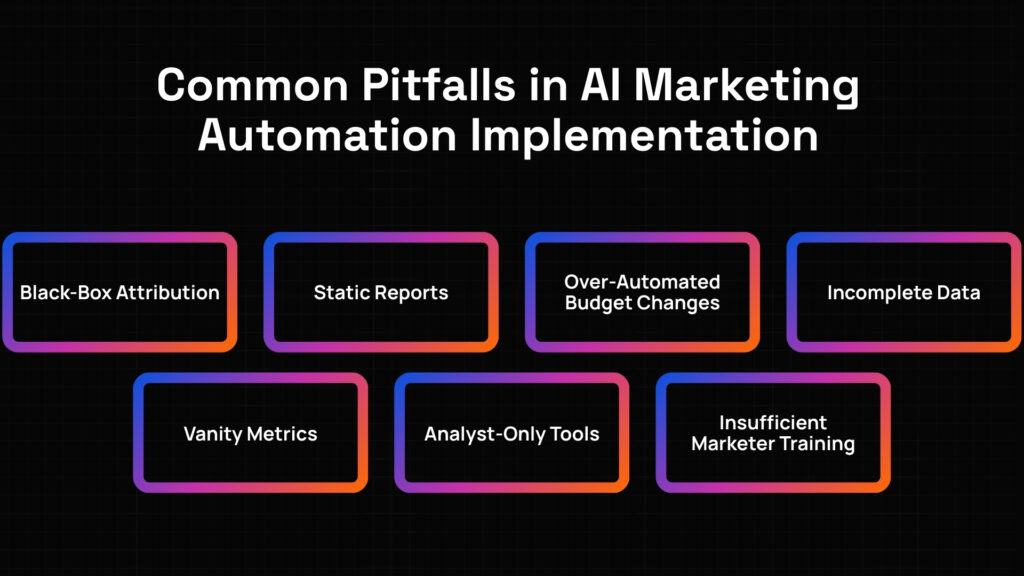
Common Pitfalls in AI Marketing Automation Implementation
AI tools promise better decisions and faster insights, but poor planning and inadequate transparency can create trust issues instead of confidence improvements. Many marketing organizations make avoidable mistakes during deployment that delay value realization and erode both analyst and executive trust. To discover proven methodologies tailored for your marketing workflows and measurement requirements, explore our AI Workflow Automation Services page for detailed AI marketing automation frameworks and real-world implementation guidance.
- Black-Box Attribution: Accepting opaque models without explanation creates distrust. Require explainable models showing logic as Gartner shows 70 percent struggling with confidence requiring transparency enabling validation not mysterious algorithms producing numbers without rationale undermining adoption.
- Static Reports: Relying on scheduled dashboards creates staleness. Real-time or daily refreshes enabling current visibility as industry guidance emphasizes reports arriving after decisions made requiring timeliness allowing agile optimization responding to performance shifts.
- Over-Automated Budget Changes: Allowing autonomous spend shifts creates control loss. Human approval for significant reallocations as Deloitte shows HITL improving trust enabling judgment when recommendations suggest major changes requiring validation before execution preventing regrettable automated decisions.
- Incomplete Data: Measuring without revenue integration provides partial view. Integrate CRM and revenue showing full funnel as AI marketing automation requires conversion data not just click metrics proving campaign effectiveness through business outcomes not engagement vanity metrics.
- Vanity Metrics: Optimizing impressions or clicks without revenue connection wastes effort. Align to revenue KPIs measuring business impact as AI automation examples should optimize CAC and ROAS not impressions creating activity without demonstrable value.
- Analyst-Only Tools: Requiring dashboard expertise limits accessibility. Plain-language outputs democratizing insights as Nielsen Norman Group shows clear explanations improving decisions enabling all stakeholders to understand performance not restricting access to technical users.
- Insufficient Marketer Training: Technical implementations without user enablement face adoption resistance. Include analyst and operator training as effective decision-making requires understanding model recommendations enabling confident action not hesitant second-guessing.
The Impact of Integration Readiness
Before launching any AI marketing automation initiative, organizations must thoroughly assess their platform architecture, data quality, and historical depth. Integration readiness evaluates how well existing marketing systems, campaign data assets, and reporting procedures can support intelligent automation without creating technical debt or measurement gaps. When marketing operations teams conduct integration audits in advance, they uncover system limitations and data quality issues early, align stakeholders around connectivity requirements, and minimize wasted time during vendor discovery and pilot phases.
Example: A B2B technology company preparing for AI automation examples mapped their ad platform and CRM connectivity, discovering their attribution models were black boxes requiring explainable logic, their reports were static requiring real-time refreshes, their budget changes lacked approval workflows requiring human gates, their CRM data was incomplete requiring revenue integration, their metrics definitions varied requiring normalization, and their historical data depth was insufficient for model training. Addressing these integration readiness issues before vendor engagement reduced the overall project timeline by five weeks.
Pro Tip: Validate historical data depth during discovery ensuring sufficient training data for models. Vendor should map data sources and refresh rates before proposals. Integrate CRM and revenue not just ad platforms as incomplete data prevents accurate attribution showing only partial customer journey.
Evaluating AI Marketing Automation ROI
Quantifying the benefits of AI tools helps secure executive buy-in and refine future investments in marketing technology. Measuring ROI goes beyond simple time savings; it captures improvements in attribution confidence, decision velocity, optimization effectiveness, and analyst capacity. Without clear financial modeling during evaluation, AI marketing automation projects risk becoming unclear implementations that fail to justify ongoing operational expenses and licensing costs.
Key considerations for financial analysis include:
- Attribution Confidence Value: Gartner shows over 70 percent of marketing leaders struggle to trust their attribution data, calculating decision quality improvement when explainable models build confidence enabling aggressive optimization not conservative hedging as uncertainty creates risk aversion limiting growth investment.
- CAC Reduction Impact: Track customer acquisition cost decrease when better attribution directs spending to highest-converting channels, measuring efficiency gains as AI marketing automation eliminates waste on underperforming activities improving unit economics supporting scalable growth.
- Report Automation Savings: Calculate analyst hours saved when automated insights replace manual consolidation, quantifying capacity release as industry guidance emphasizes teams spending more time reporting than optimizing freeing strategic focus for creative testing and audience development.
- Decision Velocity Acceleration: Monitor days saved from insight to action when real-time updates and budget recommendations enable agile optimization, measuring competitive advantage as AI automation examples enable responsive reallocation capturing opportunities competitors miss through quarterly planning rigidity.
- ROAS Improvement Value: Assess revenue impact when data-driven models guide investment allocation, calculating incremental returns as McKinsey shows focused analytics delivering faster impact through systematic optimization identifying highest-performing combinations.
- Total Cost of Ownership: Include licensing fees, platform integration development, historical data preparation, plus ongoing model calibration, dashboard maintenance, and support in comprehensive analysis. Understand pricing scales with ad spend, conversion volume, or data complexity as marketing automation requiring realistic cost modeling.
Gartner shows over 70 percent of marketing leaders struggle to trust attribution data. McKinsey finds focused analytics initiatives deliver faster impact than enterprise-wide efforts. Deloitte demonstrates HITL improves trust in AI-driven decisions. Nielsen Norman Group shows clear explanations improve decision quality. Industry guidance emphasizes teams spending more time reporting than optimizing. When every AI marketing automation interaction logs attribution logic, model decisions, recommendation rationale, and approval workflows, every integration maintains real-time synchronization preventing stale performance data, and every quarterly review assesses attribution accuracy and market alignment, organizations build trusted marketing operations that scale without sacrificing decision confidence, optimization velocity, or strategic effectiveness.
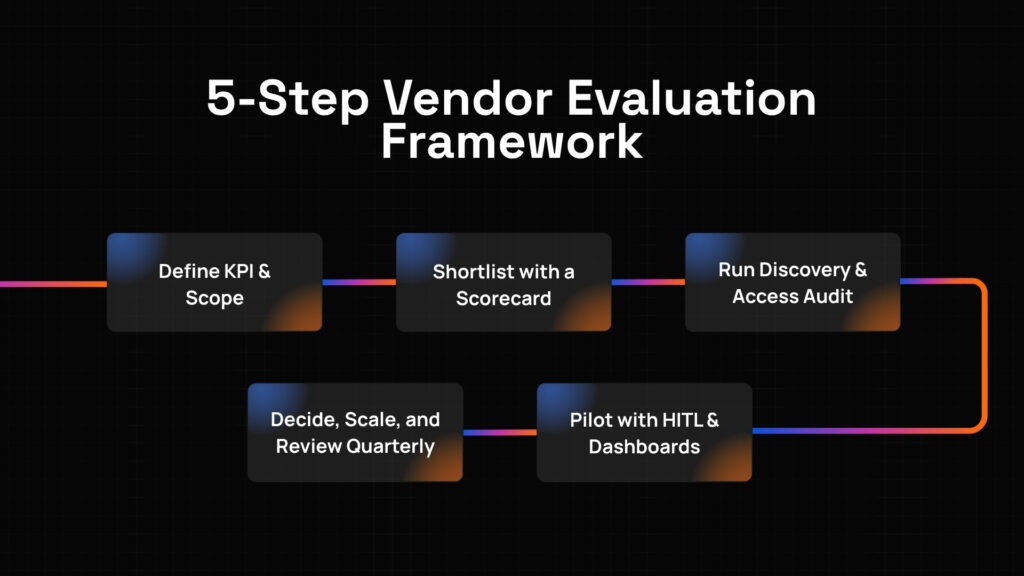
5-Step Vendor Framework for AI Marketing Automation
Selecting an AI tools vendor should follow a disciplined, structured process that aligns with your organization’s marketing goals while accounting for both technological depth and measurement requirements. Instead of focusing solely on impressive demonstrations or attribution claims, evaluation should weigh how well the AI marketing automation solution supports measurable outcomes, integrates with existing systems, and maintains trust through appropriate transparency.
1. Define KPI & Scope
Start by identifying specific measurable outcomes with narrow scope enabling quick operational validation. Defining concrete targets helps align all stakeholders including marketing leadership, analytics teams, channel managers, and finance. Your goal might be improving ROAS visibility across paid channels, reducing CAC, or increasing attribution confidence, but it must be quantifiable with clear marketing impact.
Example: A SaaS company defined its KPI as “improving ROAS visibility across paid channels by 40 percent within 90 days while maintaining attribution confidence above 4.0 out of 5.0 among marketing leaders and reducing report generation time by 50 percent.” This metric guided every AI marketing automation discussion, shaped pilot design with clear measurement benchmarks, and became the success measurement. Pick one channel group first.
Pro Tip: Document one to two primary marketing outcomes before requesting proposals. Focus on ROAS visibility improvement, CAC reduction, or attribution confidence increase tied to business impact rather than vanity metrics like dashboard count, and define specific percentage improvement targets with timelines enabling objective go/no-go decisions during pilot evaluation as McKinsey finds focused analytics delivering faster impact.
2. Shortlist with a Scorecard
Once objectives are clear, move to structured vendor comparison using a weighted scorecard evaluating AI automation examples providers. This tool allows teams to quantify how well each vendor aligns with priorities including CRM and ad platform integrations, attribution methodology, HITL design, observability, and portability and IP ownership.
Example: One enterprise assigned 30 percent weight to CRM and ad platform integrations assessing connectivity depth, 25 percent to attribution methodology evaluating explainability, 20 percent to HITL design ensuring approval workflows, 15 percent to observability capabilities, and 10 percent to portability and IP ownership. Score CRM and ad platform integrations highest.
Pro Tip: Turn evaluation criteria into numeric scoring so decisions remain defendable beyond subjective demonstration impressions. Ask how models handle missing data validating robustness. Weight appropriately as Gartner shows 70 percent struggling with trust and Deloitte emphasizes oversight importance. Have multiple stakeholders from analytics, channel management, and finance score vendors independently before group discussion to reduce bias.
3. Run Discovery & Access Audit
Before contracts are signed, a structured discovery phase maps data sources and refresh rates documenting every integration touchpoint and measurement requirement. During this phase, teams validate platform access, surface data quality gaps, and confirm attribution methodology with appropriate explainability. Validate historical data depth.
Example: An e-commerce retailer conducted discovery for AI tools, revealing their ad platforms used different conversion windows requiring normalization, their CRM lacked closed-won revenue requiring sales integration, their historical data was only six months requiring longer retention, their attribution definitions weren’t standardized requiring alignment, and their budget approval workflows weren’t documented creating governance gaps.
Pro Tip: Vendor should map data sources and refresh rates before proposals detailing exact connectivity requirements. Validate historical data depth ensuring sufficient training data for models. Ask how models handle missing data addressing inevitable gaps. Use discovery to surface platform limitations, data quality issues, and approval workflow needs before signing when negotiating leverage is highest.
4. Pilot with HITL & Dashboards
A well-designed pilot validates both technology performance and analyst acceptance under real marketing conditions. Instead of full-scale deployment, run 30-day pilot for paid search and social maintaining marketer oversight for quality assurance. Incorporating human-in-the-loop review ensures AI marketing automation outcomes align with business standards and confidence requirements while building organizational trust.
Example: A financial services company piloted AI automation examples for paid channel attribution, running 30-day evaluation with controlled deployment on search and social, marketer review of all budget recommendations before execution, and dashboard tracking ROAS visibility, attribution confidence, and insight adoption, achieving 38 percent visibility improvement with 4.2 confidence above 4.0 target. Track insight accuracy and adoption as Deloitte shows HITL matters.
Pro Tip: Execute pilots with frozen scope covering specific channel group, clear success criteria including confidence benchmarks, and measurable KPIs tracked weekly. Run 30-day pilot for paid search and social establishing AI meets standards. Measure ROAS visibility targeting 40 percent improvement and attribution confidence targeting above 4.0. Track insight adoption rates understanding actionability. Use pilot to train analysts on model interpretation and recommendation evaluation techniques.
5. Decide, Scale, and Review Quarterly
After the pilot proves both operational value and analyst trust maintenance, use findings to guide the final decision about expanding to lifecycle and retention insights validating sustainability and stability. Scaling should be deliberate, expanding only after demonstrating approach maintains quality across representative channel types and customer segments. Continuous quarterly reviews maintain measurement discipline, ensuring automation adapts as customer journeys, channel effectiveness, and business priorities evolve.
Example: A technology company conducted quarterly reviews with its AI marketing automation partner, expanding successful paid channel attribution to lifecycle analysis and retention modeling over 12 months, scaling after validation, identifying optimization opportunities improving CAC by additional 15 percent, and revisiting attribution logic quarterly. Expand to lifecycle and retention insights as McKinsey shows focused approach.
Pro Tip: Treat vendor reviews as measurement governance sessions focused on attribution accuracy and decision confidence, not just performance metrics. Expand to lifecycle and retention insights proving reliability before comprehensive deployment. Revisit attribution logic quarterly detecting journey changes and market shifts. Use quarterly reviews to assess model accuracy, insight adoption, analyst satisfaction, and alignment with evolving customer behavior and channel dynamics.
Next Steps in Your AI Marketing Automation Evaluation
By now, you should have a clear understanding of what to prioritize when selecting AI tools partners for marketing. Bringing these insights together creates a structured evaluation flow that de-risks investment and accelerates deployment while ensuring measurement trust and decision confidence.
- Align with marketing metrics: Ensure every AI marketing automation feature connects to specific KPIs like CAC, ROAS, pipeline velocity, or conversion rate tied to business impact, not just automation coverage percentages disconnected from actual marketing outcomes and measurable revenue results.
- Evaluate platform integration: Confirm that AI automation examples work smoothly with your ad platforms through real-time data access, CRM through conversion tracking, and marketing automation tools through engagement visibility as Gartner shows 70 percent struggling requiring integrated workflows from impression through revenue.
- Focus on measurement oversight: Choose vendors with approval gates for budget changes, explainable attribution models showing logic, and plain-language summaries democratizing access as Deloitte shows HITL improving trust preventing blind acceptance of opaque recommendations.
- Review observability capabilities: Favor partners with ability to trace insights back to raw data sources, dashboards showing model logic, and normalized metrics ensuring consistency as Nielsen Norman Group shows clear explanations improving decision quality enabling confident action.
- Test with controlled pilots: Always run 30-day pilots on one channel group, marketer review maintaining oversight, frozen scope on specific platforms, and adoption tracking before production deployment to validate visibility improvements, confidence maintenance, and operational readiness under real-world marketing conditions with actual campaign complexity.
With these criteria in place, you are better equipped to identify AI marketing automation vendors who not only automate reporting but also build confidence, enable decisions, maintain trust, and amplify your team’s capacity to focus on creative strategy and audience development requiring imagination that machines cannot replicate.
Vendor Questions to Ask
To make the most informed decision during your AI marketing automation evaluation, be sure to ask these essential questions:
- Which channels and CRMs do you integrate with, and what real-time capabilities do you provide for campaign performance and conversion data?
- How do you explain attribution results including model logic, channel weighting, and contribution calculation methodology?
- Can insights trigger alerts or actions including automated notifications, budget recommendations, and performance warnings?
- How is data refreshed and validated including update frequency, quality checks, and anomaly detection procedures?
- Who owns the attribution models ensuring operational portability at contract end including export rights for logic and dashboards?
- Can we export logic and dashboards enabling portability without starting over or losing measurement capability if we switch vendors?
- How do you measure success including adoption metrics, confidence tracking, and business impact validation?
- Can you provide two customer references in similar industries who can discuss attribution confidence improvements and ongoing partnership?
- What are recurring costs beyond license including integration maintenance, model calibration, and support fees, and how do expenses scale?
- What rollback capabilities exist for errors enabling quick restoration when models produce incorrect attribution or system failures?
Transform Marketing Operations with AI Marketing Automation
AI marketing automation is not just a technological investment; it is a strategic measurement capability that requires careful integration, appropriate transparency, and continuous calibration. The right implementation brings 40 percent ROAS visibility improvement, solved attribution trust gap, and freed analyst capacity, while poor execution creates data confusion and measurement distrust that undermine confidence and damage decision quality.
Ready to transform your marketing operations with AI marketing automation? Book a Free Strategy Call with us to explore the next steps and discover how we can help you decide what to automate first, validate platform readiness, and deploy the right AI tools solution for your unique channel mix, measurement framework, business objectives, and measurable marketing outcomes.