

The Power of AI Automation in Finance: Why Workflow Selection Matters
AI automation in finance has evolved from basic data entry bots into intelligent process orchestration that defines operational excellence in modern finance organizations. Finance teams implementing professional AI process automation are fundamentally transforming how reconciliations get executed, how exceptions route efficiently, and how close cycles accelerate without turning books into black boxes. Advanced AI automation use cases now manage workflows from bank reconciliations and intercompany matching to exception handling and automated posting, enabling controllers to focus on forecasting and controls while machines handle repetitive execution that once consumed days during month-end close.
The data supporting strategic finance automation continues to strengthen across operational functions. According to Deloitte research, organizations that adopted intelligent automation report approximately 31 to 32 percent cost reductions, demonstrating substantial operational returns when implementations eliminate routine work. Oracle indicates 57 percent of teams reported fewer days to close after using modern close tools, validating measurable cycle time improvements addressing the primary finance pain point of close processes. GTreasury surveys show RPA is already widely adopted in finance with more than half of respondents reporting RPA use in finance functions, proving mainstream acceptance as integration expectations rise. Gartner survey showed 55 percent of finance functions targeted a touchless close by 2025, indicating widespread strategic intent to eliminate manual intervention.
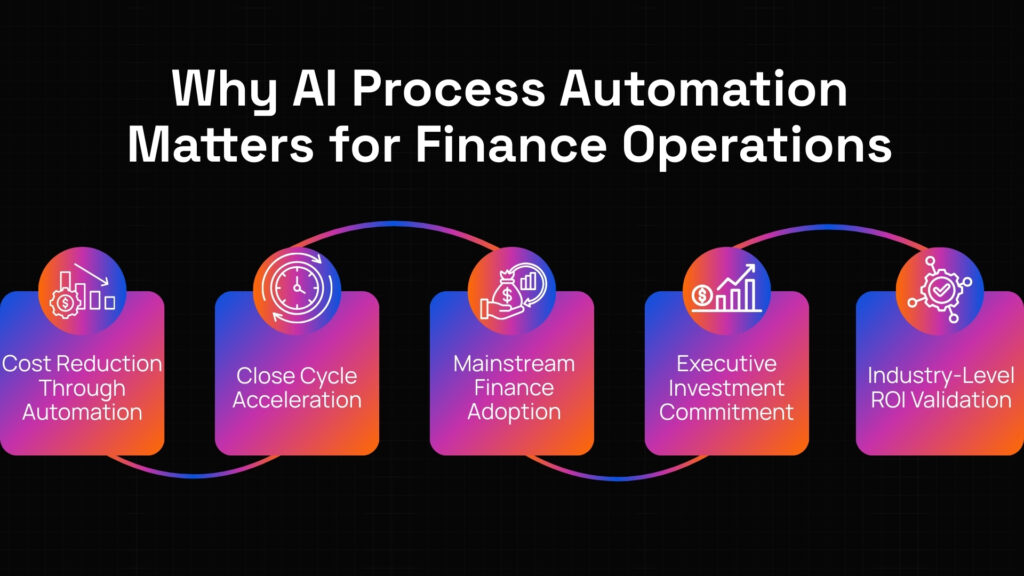
Why AI Process Automation Matters for Finance Operations
AI automation use cases extend beyond simple task automation; they transform how finance organizations manage close velocity, maintain control quality, and ensure audit compliance across all accounting workflows. Manual finance processes that once created bottlenecks through spreadsheet reconciliations, exception backlogs, and impossible close timelines can now be executed with intelligence and precision through AI process automation that compounds efficiency over time. From reducing close days from 12 to 5 to achieving 70 percent auto-match rates on reconciliations, AI automation in finance delivers measurable outcomes that strengthen both operational efficiency and control effectiveness.
For finance leaders evaluating AI process automation strategies, the AI automation use cases manifest in five critical ways:
- Cost Reduction Through Automation: Deloitte shows organizations report approximately 31 to 32 percent cost reductions from intelligent automation demonstrating substantial operational returns when implementations eliminate routine reconciliation work, exception research, and manual posting freeing finance capacity for analysis, forecasting, and strategic decision support requiring professional judgment.
- Close Cycle Acceleration: Oracle indicates 57 percent of teams reduced days to close with modern tools proving measurable cycle time improvements, as AI automation in finance handles bank reconciliations, intercompany matching, and automated posting enabling close reduction from 12 days to 5 days freeing leadership bandwidth for business partnership activities beyond close firefighting.
- Mainstream Finance Adoption: GTreasury shows more than half report RPA use in finance functions validating widespread acceptance, with Gartner indicating 55 percent targeting touchless close by 2025 demonstrating strategic commitment as AI automation use cases expand from isolated pilots to comprehensive close automation becoming competitive requirement rather than experimental advantage.
- Executive Investment Commitment: McKinsey reports many plan to increase AI investment expecting value realization, proving sustained financial commitment as finance organizations validate production returns beyond proof-of-concept demonstrations with AI process automation delivering measurable close improvements, cost reductions, and control enhancements justifying continued spending.
- Industry-Level ROI Validation: FN London notes banking and financial services expect material profit boosts from AI adoption indicating sector-wide value capture, as AI automation in finance becomes strategic imperative not just operational improvement with competitive pressure driving adoption as laggards risk disadvantage from slower closes and higher operating costs.
AI automation in finance is not about replacing controllers or accountants; it is about freeing finance to do forecasting and controls not spreadsheet surgery through workflow optimization enabling finance professionals to focus capacity on complex judgment, business partnership, and strategic analysis that machines cannot replicate effectively.
Key Considerations When Choosing AI Automation in Finance Partners
Selecting the right AI process automation requires careful alignment between technology capabilities and finance requirements. The most successful AI automation in finance implementations are built on a foundation of auditability, deep ERP integration, and measurable impact on critical metrics like days-to-close, auto-match rates, and exception reduction.
Below are the core factors that should guide every AI automation in finance decision:
- Business Outcomes & KPI Alignment: Every AI process automation initiative must connect directly to tangible finance metrics including days-to-close reduction, percent auto-reconciled improvement, DSO optimization, or FTE reallocation. Vendors should map features to clear targets with measurable baselines rather than generic efficiency promises disconnected from actual close performance and cost outcomes.
- Integration with Finance Systems: Effective AI automation in finance depends on seamless connectivity with ERP and general ledger platforms, banking feeds, accounts payable and receivable systems, treasury management systems, and identity platforms. Confirm read-write access plus event-driven hooks enabling near-real-time reconciliations as Oracle shows 57 percent reduce close time requiring deep integration not batch processing creating delays.
- Security and Governance: AI automation use cases handle sensitive financial data including transactions, account balances, and bank statements requiring SOC 2 compliance, encryption at rest and in flight, data residency options, and audit trails for every automated decision. Address control requirements as Deloitte shows 31 percent cost reductions requiring appropriate governance not uncontrolled automation.
- Human-in-the-Loop (HITL) Design: Successful AI automation in finance always includes accountant oversight with configurable thresholds for exceptions, human-approval gates for high-dollar or unusual items, and transparent reasoning for automated matches. Start HITL for top 20 percent of dollar-value exceptions as Gartner shows 55 percent targeting touchless close requiring careful balance between automation and control.
- Observability and Auditability: Transparency is essential when scaling AI process automation across accounting workflows. A capable vendor provides per-transaction traces enabling audit, real-time dashboards tracking performance, evaluation sets measuring model drift, and comprehensive audit logs documenting automated decisions supporting external audit and internal control reviews.
- Pricing Transparency and Flexibility: Clarify pricing ranges including volume assumptions, read-write call charges, and storage fees with detailed breakdown. Document who owns prompts, models, and transformation logic developed during implementation preventing vendor lock-in as GTreasury shows over half using RPA requiring sustainable partnerships enabling continuous improvement.
Choosing AI automation in finance partners who understand these requirements ensures your investment delivers sustainable improvements rather than creating control gaps, vendor lock-in, or audit vulnerabilities that limit future flexibility when accounting standards, regulations, or business workflows evolve.
Understanding AI Automation Use Cases: 3 Core Finance Workflows
Before launching any AI process automation initiative, organizations must thoroughly understand specific workflows demonstrating production readiness. Use case clarity prevents over-automation of judgment-heavy work creating control failures. When finance teams identify proven automation candidates, they accelerate value realization, maintain control quality, and avoid expensive failures from automating complex accounting estimates inappropriately.
Reconciliations (Workflow 1): Bank reconciliations and intercompany matching handle high-volume repetitive comparison work. AI automation in finance parses statements, matches transactions using fuzzy logic, and flags exceptions for review achieving 70 percent auto-match rates as Oracle shows 57 percent reduce close time through automated reconciliation addressing primary bottleneck in close process.
Exception Handling (Workflow 2): Intelligent routing sends exceptions to appropriate reviewers based on dollar thresholds, account type, or complexity patterns. AI process automation classifies variances, enriches with supporting documentation, and escalates high-risk items requiring senior review as Deloitte shows 31 percent cost reductions through efficient exception resolution reducing research time and backlog aging.
Close Automation (Workflow 3): Automated posting executes standard journal entries based on reconciliation results and business rules. AI automation use cases demonstrate rule-following GL postings, accrual calculations, and intercompany eliminations enabling close reduction from 12 days to 5 days as Gartner shows 55 percent targeting touchless close through comprehensive automation across reconciliation, exception, and posting workflows.
Pro Tip: Start with one account type proving value on narrow focused implementation. Example includes reducing close days from 12 to 5 for entity A through bank and intercompany reconciliation automation as GTreasury shows over half using RPA requiring focused excellence demonstrating measurable results before comprehensive deployment across all account types simultaneously.
Understanding AI Automation in Finance KPIs: What to Measure
Before launching any AI process automation initiative, organizations must thoroughly define success metrics enabling objective pilot evaluation and ongoing performance monitoring. Key performance indicators provide the measurement framework distinguishing valuable implementations from expensive failures creating finance team skepticism. When finance operations teams establish KPIs in advance, they align stakeholders around clear targets, enable data-driven optimization, and build business cases justifying continued investment through demonstrated value.
- Days-to-Close: Track cycle median and variance measuring close acceleration when AI automation in finance handles reconciliations and posting, targeting reductions like 12 days to 5 days as Oracle shows 57 percent achieve fewer close days proving substantial cycle time improvements addressing primary finance pain point.
- Auto-Match Rate: Monitor percent of reconciliations auto-matched targeting above 70 percent when AI process automation handles transaction comparison, measuring automation effectiveness as higher rates indicate strong matching logic and data quality while lower rates suggest configuration refinement or data cleansing needs.
- Exception Backlog Age: Evaluate days exceptions remain unresolved measuring efficiency improvements when intelligent routing accelerates review, targeting reduction in aged items as AI automation use cases demonstrate classification and prioritization preventing backlog accumulation consuming capacity during peak close periods.
- FTE-Hours Saved: Calculate monthly time reduction through before-after time studies when AI automation in finance handles routine work, quantifying operational efficiency as Deloitte shows 31 percent cost reductions requiring accurate baseline and post-implementation measurement validating financial returns justifying licensing costs.
- DSO Improvement: Track days sales outstanding changes when automated collections and cash application accelerate receivables, measuring working capital impact as AI process automation handles payment matching and dunning communications affecting cash conversion cycles beyond pure accounting efficiency.
- Manual Journal Adjustments Avoided: Count prevented entries when reconciliation accuracy improves through automation, measuring quality enhancement as fewer adjustments indicate effective matching reducing close complexity and audit risk from extensive manual intervention correcting automated processing errors.
- SLA Adherence: Monitor finance ticket closure within committed timeframes measuring service quality when exception routing improves, tracking performance as Gartner shows 55 percent targeting touchless close requiring reliable execution meeting internal customer expectations not just cost reduction.
Pro Tip: Measure 4-week baseline before pilots establishing clear starting point. Freeze scope to one account type during validation measuring automated match rate and exception reduction proving value before expansion, as Oracle shows 57 percent reduce close time requiring accurate measurement demonstrating improvement not just deployment activity.
The Impact of Integration Readiness
Before launching any AI automation in finance initiative, organizations must thoroughly assess their ERP architecture, data quality, and API capability completeness. Integration readiness evaluates how well existing finance systems, master data, and accounting procedures can support intelligent automation without creating technical debt or control gaps. When finance operations teams conduct integration audits in advance, they uncover system limitations and data quality issues early, align stakeholders around connectivity requirements, and minimize wasted time during vendor discovery and pilot phases.
Example: A manufacturing company preparing for AI process automation mapped their ERP and banking integration, discovering their general ledger lacked real-time APIs requiring batch file processing creating delay, their bank feeds used inconsistent formats across institutions requiring custom parsers, their chart of accounts contained inactive segments preventing clean matching, their intercompany transactions lacked standardized reference numbers creating reconciliation complexity, and their data retention policies weren’t documented creating ambiguity about audit trail requirements. Addressing these integration readiness issues before vendor engagement reduced the overall project timeline by seven weeks.
Pro Tip: Include data lineage and compliance check in discovery documenting how transaction data flows through systems. Vendor should list required API scopes, sample data types, and SSO flows before proposals. Use Integration Readiness Checklist confirming API, data, and security gaps preparing comprehensive pilot validation ensuring connectivity and control framework readiness.
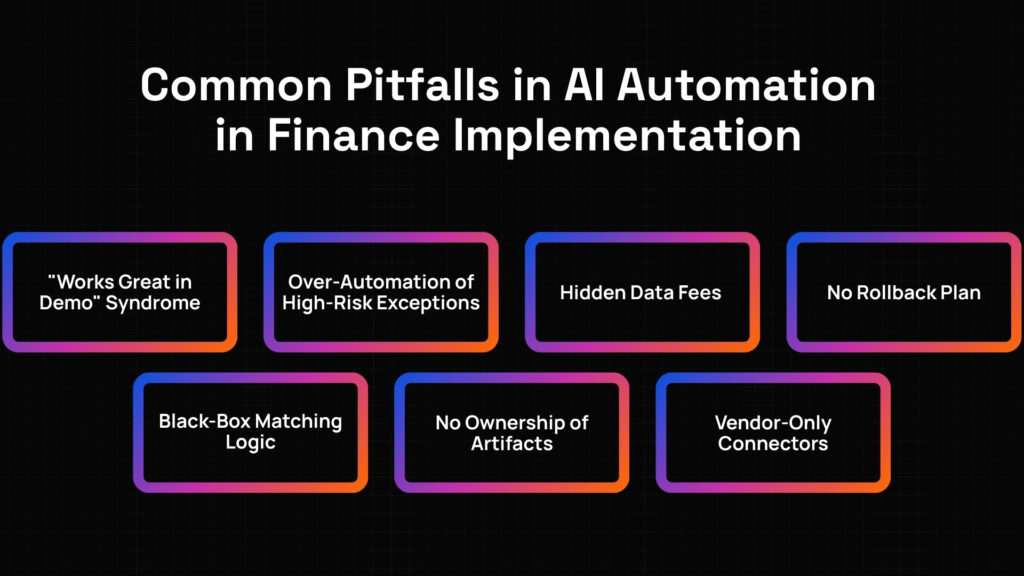
Common Pitfalls in AI Automation in Finance Implementation
AI process automation promises close acceleration and cost reduction, but poor planning and inadequate controls can create audit issues instead of efficiency improvements. Many finance organizations make avoidable mistakes during deployment that delay value realization and erode both team and auditor trust. To discover proven methodologies tailored for your finance workflows and control requirements, explore our AI Workflow Automation Services page for detailed AI automation in finance frameworks and real-world implementation guidance addressing AI automation challenges.
- “Works Great in Demo” Syndrome: Organizations accepting vendor demonstrations without validation discover production surprises. Insist on pilot with your data and KPIs proving performance under actual conditions including data quality issues, unusual transactions, and peak volume periods as Deloitte shows 31 percent cost reductions requiring realistic assessment not sanitized demonstrations.
- Over-Automation of High-Risk Exceptions: Deploying autonomous handling for complex items creates control failures. Start HITL for top 20 percent of dollar-value exceptions requiring human review preventing situations where automation processes material transactions inappropriately as Oracle shows 57 percent reduce close time through appropriate automation not reckless deployment.
- Hidden Data Fees: Pricing without usage assumptions creates budget surprises. Get read-write call and storage assumptions in writing documenting how costs scale with transaction volume, reconciliation frequency, and data retention preventing situations where production usage costs exceed initial projections dramatically.
- No Rollback Plan: Launching without reversion capability creates risk when automation produces incorrect postings. Demand rollback playbook and data snapshots enabling quick restoration when AI automation in finance generates erroneous entries, mismatches transactions, or experiences technical failures threatening financial statement accuracy.
- Black-Box Matching Logic: Accepting opaque decision-making prevents troubleshooting and audit validation. Require explainability logs and sample rules showing why specific transactions were matched or flagged as exceptions, enabling finance review and external audit understanding as GTreasury shows over half using RPA requiring transparency supporting controls.
- No Ownership of Artifacts: Contracts without export provisions create operational dependency preventing competitive negotiations and future flexibility. Require exports of prompts, evaluation sets, and transformation scripts ensuring you can switch vendors, bring automation in-house, or iterate independently without losing operational capability.
- Vendor-Only Connectors: Proprietary integration creates lock-in and inflexibility. Confirm use of standard APIs and exportable data formats enabling portability as Gartner shows 55 percent targeting touchless close requiring architectural control not vendor dependency threatening operational continuity.
Evaluating AI Automation Challenges Through Finance ROI
Quantifying the benefits of AI automation in finance helps secure executive buy-in and refine future investments in accounting technology while addressing AI automation challenges including implementation complexity and change management. Measuring ROI goes beyond simple time savings; it captures gains in close velocity, exception efficiency, control quality, and FTE capacity. Without clear financial modeling during evaluation, AI process automation projects risk becoming unclear implementations that fail to justify ongoing operational expenses and licensing costs.
Key considerations for financial analysis include:
- Cost Reduction Achievement: Deloitte shows organizations report approximately 31 to 32 percent cost reductions from intelligent automation providing optimistic scenario for modeling, measuring savings from eliminated manual reconciliation work, reduced exception research time, and prevented overtime during close periods calculating total operational returns.
- Close Cycle Value: Oracle indicates 57 percent reported fewer days to close calculating value from accelerated financial reporting enabling faster executive decision-making, reduced close period stress improving employee satisfaction, and absorbed volume growth without proportional hiring as AI automation use cases demonstrate cycle time improvements.
- FTE Capacity Release: Track hours saved monthly when AI automation in finance handles routine work calculating freed capacity redirected to forecasting, variance analysis, and business partnership as controllers shift from transaction processing to strategic finance activities requiring professional judgment beyond machine capabilities.
- Exception Processing Efficiency: Measure backlog reduction and resolution speed improvements when intelligent routing accelerates review, calculating productivity gains from targeted exception handling and prevented aged item accumulation as AI process automation classifies, enriches, and escalates appropriately reducing research cycles.
- Working Capital Optimization: Calculate DSO improvement value when automated collections and cash application accelerate receivables, measuring cash flow benefits from faster payment matching and dunning communications as AI automation in finance extends beyond accounting to treasury optimization affecting enterprise liquidity.
- Total Cost of Ownership: Include licensing or usage fees, API integration expenses, professional services, plus ongoing model monitoring, control testing, and audit support costs in comprehensive analysis. Understand pricing scales with transaction volume and reconciliation frequency requiring sensitivity modeling as GTreasury shows over half using RPA with varied cost structures.
Deloitte shows approximately 31 to 32 percent cost reductions from intelligent automation. Oracle indicates 57 percent reported fewer days to close with modern tools. GTreasury surveys show more than half report RPA use in finance functions. Gartner showed 55 percent target touchless close by 2025. McKinsey reports many plan to increase AI investment this year. When every AI automation in finance interaction logs transaction matching logic, exception routing decisions, automated posting rules, and approval workflows, every reconciliation change validates through parallel testing before production deployment, and every quarterly review assesses model drift and control effectiveness, organizations build trusted finance operations that scale without sacrificing audit quality, financial statement accuracy, or regulatory compliance.
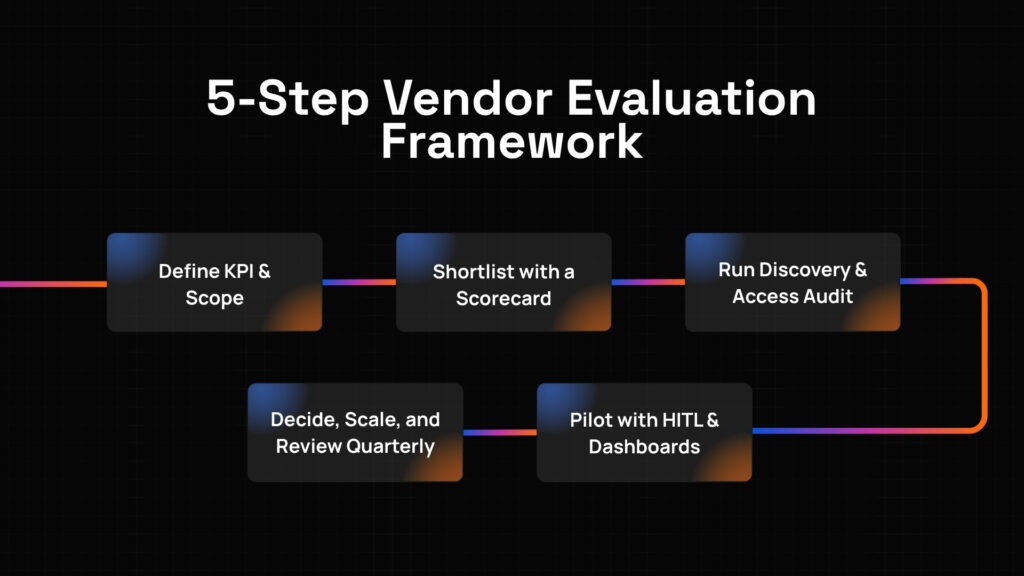
5-Step Vendor Framework for AI Automation in Finance
Selecting an AI process automation vendor should follow a disciplined, structured process that aligns with your organization’s finance goals while accounting for both technological depth and audit compliance. Instead of focusing solely on impressive demonstrations or efficiency claims, evaluation should weigh how well the AI automation in finance solution supports measurable outcomes, integrates with existing systems, and maintains controls through appropriate governance.
1. Define KPI & Scope
Start by identifying specific measurable outcomes with narrow scope enabling quick value proof. Defining concrete targets helps align all stakeholders including finance leadership, accounting operations, IT infrastructure, and internal audit. Your goal might be reducing close days from 12 to 5 for entity A, achieving 70 percent auto-match rate, or saving 40 percent exception hours, but it must be quantifiable with clear financial impact.
Example: A distribution company defined its KPI as “reducing close days from 12 to 5 for entity A within 90 days while maintaining 70 percent auto-match rate on bank reconciliations and reducing exception backlog age below 5 days.” This metric guided every AI automation in finance discussion, shaped pilot design with clear accounting benchmarks, and became the success measurement. Measure 4-week baseline before pilots establishing starting point.
Pro Tip: Document one to three primary finance outcomes before requesting proposals. Focus on days-to-close reduction, auto-match rate improvement, or FTE-hours saved tied to operational efficiency rather than vanity metrics like total transactions processed, and define specific percentage improvement targets with timelines enabling objective go/no-go decisions during pilot evaluation as Oracle shows 57 percent achieve close time reductions.
2. Shortlist with a Scorecard
Once objectives are clear, move to structured vendor comparison using a weighted scorecard evaluating AI process automation providers. This tool allows teams to quantify how well each vendor aligns with priorities including integration depth, security and governance, HITL design, observability, references and delivery, and pricing transparency.
Example: One enterprise assigned 25 percent weight to integration depth with ERP and banking systems, 20 percent to security and governance meeting SOC 2 requirements, 15 percent each to HITL design and observability capabilities, 15 percent to references and delivery support, and 10 percent to pricing transparency. Weight KPIs 2x other criteria for scoring ensuring focus on measurable outcomes.
Pro Tip: Turn evaluation criteria into numeric scoring so decisions remain defendable beyond subjective demonstration impressions. Score integration, security, HITL, observability, references, and pricing 1 to 5. Weight appropriately as Deloitte shows 31 percent cost reductions and Gartner indicates 55 percent target touchless close requiring proven approaches. Have multiple stakeholders from accounting, IT, and audit score vendors independently before group discussion to reduce bias.
3. Run Discovery & Access Audit
Before contracts are signed, a structured discovery phase maps required API scopes, sample data types, SSO flows, and compliance requirements documenting every integration touchpoint and control need. During this phase, teams validate connector capabilities, surface data quality gaps, and confirm security controls with appropriate permissions. Include data lineage and compliance check.
Example: A healthcare organization conducted discovery for AI automation in finance, revealing their ERP required custom API authentication not in standard vendor documentation, their banking feeds contained unstructured remittance data requiring custom parsing, their chart of accounts had inconsistent segment usage preventing automated classification, their intercompany transactions lacked unique identifiers creating matching ambiguity, and their audit requirements mandated transaction-level retention not addressed in standard vendor proposals.
Pro Tip: Vendor should list required API scopes, sample data types, and SSO flows before proposals documenting exact integration requirements. Include data lineage and compliance check validating how transaction data flows supporting audit trail requirements. Use discovery to surface integration limitations, data quality gaps, and control requirements before signing when negotiating leverage is highest.
4. Pilot with HITL & Dashboards
A well-designed pilot validates both technology performance and control effectiveness under real finance conditions. Instead of full-scale deployment, run 6-week pilot processing 20 percent of monthly reconciliations with human review maintaining accountant oversight for quality assurance. Incorporating human-in-the-loop review ensures AI automation use cases align with control standards and audit requirements while building organizational confidence.
Example: A technology company piloted AI process automation for bank reconciliations, running 6-week evaluation with controlled deployment on cash accounts, human review for exceptions above $5,000 or with unusual characteristics, and dashboard tracking auto-match rate, exception reduction, and days-to-close impact, achieving 73 percent auto-match rate with 38 percent exception hour reduction. Freeze scope to one account type measuring performance as Deloitte shows 31 percent cost reductions achievable with disciplined pilots.
Pro Tip: Execute pilots with frozen scope covering specific account type, clear success criteria including control benchmarks, and measurable KPIs tracked weekly. Run 6-week pilot with 20 percent of monthly volume establishing statistical significance. Measure automated match rate targeting above 70 percent and exception reduction targeting 40 percent fewer hours. Test rollback procedure during pilot validating reversion capability. Use pilot to train accountants on exception handling and override procedures.
5. Decide, Scale, and Review Quarterly
After the pilot proves both operational value and control maintenance, use findings to guide the final decision about scaling in waves by entity or process validating sustainability and stability. Scaling should be deliberate, expanding only after demonstrating approach maintains quality across representative transaction volumes and account complexity. Continuous quarterly reviews maintain financial discipline, ensuring automation adapts as business entities, account structures, and transaction patterns evolve.
Example: A manufacturing company conducted quarterly reviews with its AI automation in finance partner, expanding successful bank reconciliation to intercompany and fixed assets over 12 months, scaling in waves after validation, identifying optimization opportunities reducing close by additional 2 days, and reviewing SLA breach trends quarterly as Oracle shows 57 percent reduce close time requiring ongoing governance. Maintain quarterly model evaluation and governance review.
Pro Tip: Treat vendor reviews as control governance sessions focused on audit quality and accuracy, not just performance metrics. Scale in waves by entity or process proving reliability before comprehensive deployment. Review SLA breach trends, exception classification accuracy, and control effectiveness quarterly. Use quarterly reviews to assess model drift from changing transaction patterns, new account structures, and evolving business requirements maintaining automation effectiveness over time.
Next Steps in Your AI Automation in Finance Evaluation
By now, you should have a clear understanding of what to prioritize when selecting AI process automation partners for finance. Bringing these insights together creates a structured evaluation flow that de-risks investment and accelerates deployment while ensuring audit compliance and control quality.
- Align with finance metrics: Ensure every AI automation use cases feature connects to specific KPIs like days-to-close, auto-match rate, or exception hours tied to operational efficiency, not just automation coverage percentages disconnected from actual close performance and measurable cost outcomes.
- Evaluate ERP integration: Confirm that AI automation in finance works smoothly with your ERP, GL, banking feeds, and AP/AR systems through real APIs or documented batch processes with read-write access and event-driven hooks enabling near-real-time reconciliations as Oracle shows 57 percent reduce close time requiring deep connectivity.
- Focus on auditability: Choose vendors with transaction-level audit logs documenting decisions, explainability showing matching logic, human approval gates for high-dollar exceptions, and comprehensive traces supporting external audit as Deloitte shows 31 percent cost reductions requiring appropriate controls not unguarded automation.
- Review observability capabilities: Favor partners with real-time dashboards tracking performance, evaluation sets measuring model drift, per-transaction traces enabling troubleshooting, and rollback playbooks allowing quick reversion when automation degrades accuracy or creates control issues.
- Test with controlled pilots: Always run 6-week pilots with 20 percent volume, human review for exceptions, frozen scope on one account type, and measured KPIs before full deployment to validate close improvements, control maintenance, and operational readiness under real-world finance conditions with actual data quality challenges.
With these criteria in place, you are better equipped to identify AI automation in finance vendors who not only automate workflows but also reduce close time, improve exception efficiency, maintain audit quality, and amplify your team’s capacity to focus on forecasting and strategic analysis requiring professional judgment that machines cannot replicate.
Vendor Questions to Ask
To make the most informed decision during your AI automation in finance evaluation, be sure to ask these essential questions:
- How do you integrate with our ERP, GL, and banking feeds including real APIs versus batch files, and what read-write actions are required?
- Do you provide transaction-level audit logs and explainability for automated matches showing decision logic and confidence scores?
- What percent of reconciliations do you typically auto-match in firms like ours with similar account complexity and data quality?
- What security certifications and data residency options do you support including SOC 2, encryption standards, and audit trail retention?
- Describe the human-in-the-loop workflow including how exceptions are escalated, what dollar thresholds trigger review, and what context is provided?
- What monitoring dashboards and alerting do you provide out-of-the-box tracking auto-match rates, exception aging, and control metrics?
- How do you measure model drift and what are your retraining policies ensuring accuracy as transaction patterns and account structures evolve?
- What are your standard pilot success criteria and typical timeline including recommended KPIs and measurement approaches?
- What artifacts are exported at contract end including prompts, evaluation sets, and runbooks ensuring operational portability?
- Can I speak to two customer references in similar industries who can discuss close time improvements, cost reductions, and ongoing partnership quality?
Transform Finance Operations with AI Automation in Finance
AI automation in finance is not just a technological investment; it is a strategic operational capability that requires careful planning, appropriate controls, and continuous performance monitoring. The right implementation brings faster close cycles, reduced costs, and improved efficiency across 3 core workflows, while poor execution creates control gaps and audit issues that undermine confidence and threaten financial statement accuracy.
Ready to transform your finance operations with AI automation in finance? Book a Free Strategy Call with us to explore the next steps and discover how we can help you scope pilots, validate control effectiveness, and deploy the right AI process automation solution for your unique ERP environment, reconciliation workflows, audit requirements, and measurable close cycle outcomes.