
The Power of Understanding How AI Agents Work: Why Architecture Matters
How do AI agents work has evolved from theoretical question into mission-critical operational knowledge that defines deployment success in modern business systems. Teams understanding professional AI agents architecture are fundamentally transforming how tool integration operates, how memory maintains, and how goal optimization executes without creating unbounded behavior or governance gaps. Advanced AI agent examples now manage workflows through observe-reason-act-evaluate loops, tool permission structures, and memory architectures, enabling operations leaders to focus on strategic initiatives while machines handle systematic coordination that once consumed hours daily during complex workflow operations.
The data supporting architectural understanding continues to strengthen across operational functions. According to Gartner research, control, observability, and data access are the top blockers to scaling AI agents, demonstrating that governance architecture determines adoption as teams requiring clarity about mechanics prevent deployment when operational understanding insufficient creating hesitation. Microsoft research shows multi-step agents outperform single-prompt systems on complex tasks, proving that iterative architecture enables superior execution as continuous feedback loop enables adaptive completion not achievable through isolated interactions. McKinsey reports limiting early write access reduces production incidents, validating that permission architecture enhances safety as read-only validation proves capability before enabling modification preventing data corruption.
Why Understanding How AI Agents Work Matters for Operations
AI agent examples extend beyond surface capabilities; they transform how operations organizations manage architectural design, maintain structural discipline, and ensure controlled execution across all workflow touchpoints. Manual operations processes that once created bottlenecks through ad-hoc tooling, ephemeral context, and unclear objectives can now be executed with intelligence and precision through AI agents that compound reliability over time. From achieving 2X complex task success through iterative loops to reducing production incidents by 50 percent through limited write access, understanding how do AI agents work delivers measurable outcomes that strengthen both operational efficiency and deployment safety.
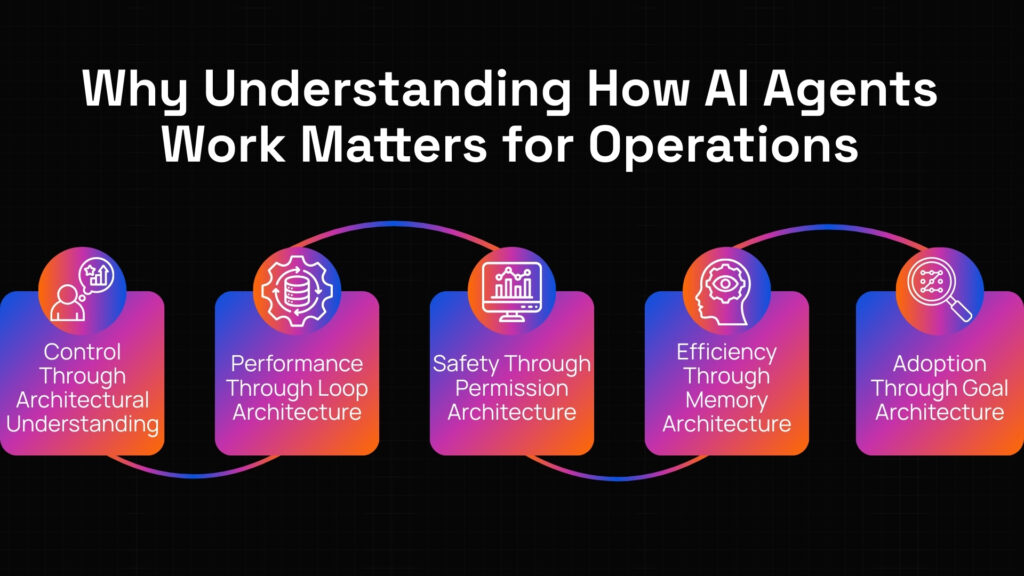
For operations leaders evaluating AI agents strategies, understanding how do AI agents work provides five critical benefits:
- Control Through Architectural Understanding: Gartner shows control, observability, and data access are top blockers to scaling AI agents, proving that architectural clarity enables deployment as teams understanding tool permissions, memory structures, and goal definitions address governance concerns preventing adoption when mechanics opaque.
- Performance Through Loop Architecture: Microsoft research shows multi-step agents outperform single-prompt systems on complex tasks demonstrating structural value, as AI agents following observe-reason-act-evaluate loop achieve superior completion through continuous feedback enabling course correction until successful execution.
- Safety Through Permission Architecture: McKinsey reports limiting early write access reduces production incidents validating control value, as AI agent examples starting read-only prove capability before enabling modification as permission progression prevents data corruption creating expensive recovery requiring systematic validation.
- Efficiency Through Memory Architecture: Industry guidance emphasizes memory enables context maintenance beyond single steps, as short-term context, long-term memory, and external storage working together enable consistent execution as agents remembering customer tier while storing decisions systematically prevent repeated data gathering.
- Adoption Through Goal Architecture: Accenture research indicates clear KPIs improve agent reliability and adoption proving definition importance, as narrow measurable time-bound goals enable focused optimization as “reduce average handle time by 15 percent” provides concrete target unlike vague “improve support quality” creating ambiguity.
Understanding how do AI agents work is not about theoretical knowledge; it is about establishing architectural discipline systematically through structural clarity enabling operations professionals to focus capacity on appropriate component design, governance implementation, and controlled deployment that matches actual mechanics not marketing abstraction.
Understanding How Do AI Agents Work: The Core Loop
Before launching any AI agents initiative, organizations must thoroughly understand operational loop and execution architecture. Nearly every agent follows same loop as processing pattern enables reliability. When operations teams understand core loop, they accelerate appropriate deployment, maintain realistic expectations, and avoid expensive failures from architectural misconceptions creating execution issues.
Four-Step Core Loop: Observe context gathering information from systems and users. Reason about options deciding appropriate next action through analysis. Use tools to act executing decisions in connected systems. Evaluate outcomes assessing results and determining continuation as this loop repeats until goal met or human steps in enabling adaptive execution.
Continuous Iteration: Loop repeats until goal met or human steps in maintaining persistence. Multi-step capability as agents handle complete workflows not isolated interactions as Microsoft shows multi-step agents outperforming single-prompt systems through iterative processing enabling superior completion on complex tasks.
Working Example: Agent reads ticket gathering context. Checks CRM enriching understanding with history. Updates field recording information systematically. Drafts response preparing communication. Escalates if confidence low maintaining quality control demonstrating complete workflow through structured loop execution.
Pro Tip: Loop repeats until goal met or human steps in ensuring completion. Start with read-only access before enabling writes validating capability as McKinsey emphasizes permission progression reducing production incidents through controlled deployment.
Understanding AI Agent Examples: 3 Real Workflow Patterns
Before launching any AI agents initiative, organizations must thoroughly understand pattern types and deployment contexts. These are proven practical patterns as validation enables informed deployment. When operations teams identify pattern types, they accelerate value realization, maintain capability alignment, and avoid expensive failures from pattern mismatch creating execution issues.
- Task Agents (Pattern 1): Handle one workflow end to end providing complete automation. Ticket triage demonstrating focused capability as single workflow scope enables optimization. Ideal for first pilots building confidence through controlled deployment as focused agents prove value before expanding requiring complexity management.
- Tool-Using Agents (Pattern 2): Coordinate across systems enabling cross-platform workflows. CRM updates plus email follow-ups demonstrating integration as multi-system capability handles complete processes. Limit permissions early building confidence as McKinsey emphasizes controlled access reducing incidents through permission progression.
- Monitoring Agents (Pattern 3): Watch for signals not actions enabling surveillance. Flag stalled deals demonstrating detection as continuous observation identifies exceptions. Separate detection from execution maintaining control as PwC shows monitoring reducing manual review through systematic surveillance requiring appropriate escalation not autonomous correction.
Pro Tip: Ideal for first pilots proving capability through task agents. Separate detection from execution maintaining governance as monitoring patterns should surface exceptions enabling human decision not triggering autonomous actions creating risk.
Understanding How Do AI Agents Work KPIs: What to Measure
Before launching any AI agent examples initiative, organizations must thoroughly define success metrics enabling objective pilot evaluation and ongoing performance monitoring. Key performance indicators provide the measurement framework distinguishing valuable implementations from expensive failures creating operations team skepticism. When operations teams establish KPIs in advance, they align stakeholders around clear targets, enable data-driven optimization, and build business cases justifying continued investment through demonstrated value.
- Complex Task Success Rate: Track completion on multi-step workflows measuring loop effectiveness when AI agents execute sequences, targeting improvements like 2X as Microsoft shows multi-step agents outperforming single-prompt systems through iterative architecture.
- Production Incident Count: Monitor errors from agent actions measuring safety when permission controls prevent corruption, targeting reductions like 50 percent as McKinsey shows limiting early write access reducing incidents through controlled deployment.
- Handle Time Reduction: Calculate duration decrease per workflow measuring efficiency when tool integration accelerates execution, targeting improvements like 15 percent as systematic coordination eliminates manual handoffs consuming time.
- Memory Consistency Score: Evaluate context preservation across interactions measuring architecture effectiveness, maintaining high consistency as memory enables workflow completion preventing repeated data gathering creating frustration.
- Goal Achievement Rate: Track percent of defined objectives reached measuring focus effectiveness, ensuring completion as narrow measurable time-bound goals enable optimization as Accenture shows clear KPIs improving reliability.
- Tool Access Incidents: Monitor unauthorized operations measuring permission effectiveness, minimizing violations as read-only progression proves capability before write access preventing data corruption.
- Escalation Appropriateness: Calculate percent of human handoffs with genuine complexity measuring routing effectiveness, ensuring escalations represent situations requiring judgment as excessive escalation indicates poor confidence while insufficient suggests inappropriate autonomy.
- Adoption Rate: Assess team utilization measuring acceptance, ensuring usage as unused automation wastes investment indicating poor targeting or insufficient architectural understanding requiring education.
Pro Tip: Avoid cross-team agents early building confidence through focused deployment. Review error logs weekly during pilot improving reliability as Gartner emphasizes control requiring systematic validation proving architecture before expansion.
Common AI Agents Pitfalls
Understanding how do AI agents work promises efficiency and better execution, but poor architectural planning and inadequate component design can create chaos instead of workflow improvements. Many operations organizations make avoidable mistakes during deployment that delay value realization and erode both leadership and team trust. To discover proven methodologies tailored for your operational workflows and architectural requirements, explore our AI Workflow Automation Services page for detailed AI agents frameworks and real-world implementation guidance.
- Unbounded Goals: Allowing vague objectives creates scattered behavior. Narrow scope defining specific targets as AI agents must optimize toward concrete goals preventing exploration beyond intended focus as Accenture emphasizes clear KPIs improving reliability through defined objectives.
- Hidden Prompts: Accepting opaque logic creates vendor lock-in. Demand transparency accessing underlying instructions as intellectual property control enables portability and customization not black-box dependencies preventing migration or optimization.
- No Rollback: Deploying without reversible actions creates permanent errors. Require reversible actions enabling correction as AI agent examples should support undo preventing irreversible mistakes from incorrect tool usage creating data corruption.
- Missing Logs: Operating without documentation creates accountability gaps. Log every step preserving complete history as loop execution requires comprehensive documentation supporting troubleshooting and identifying improvement opportunities through pattern analysis.
- Over-Automation: Allowing excessive autonomy creates quality risk. Keep humans accountable maintaining oversight as AI agents should assist not replace judgment as Accenture shows human-in-the-loop improving adoption enabling professional validation.
- Poor Memory Governance: Treating memory casually creates data risk. Audit memory like production data as persistent storage creates compliance obligations requiring systematic management not ephemeral treatment.
- Excessive Write Access: Enabling modification prematurely creates corruption risk. Limit permissions early as McKinsey shows controlling access reducing incidents through permission progression validating behavior before enabling writes.

The Impact of Integration Readiness
Before launching any AI agents initiative, organizations must thoroughly assess their system architecture, permission structure, and goal clarity. Integration readiness evaluates how well existing operational systems, tool access procedures, and objective definitions can support intelligent automation without creating technical debt or execution gaps. When operations teams conduct integration audits in advance, they uncover system limitations and architectural issues early, align stakeholders around component requirements, and minimize wasted time during vendor discovery and pilot phases.
Example: A software company preparing for AI agent examples mapped their tool connectivity and architectural readiness, discovering they had unbounded goals requiring narrow scope definition, hidden prompts requiring transparency demands, no rollback requiring reversible actions implementation, missing logs requiring comprehensive step documentation, and over-automation risks requiring human accountability maintenance. Addressing these integration readiness issues before vendor engagement reduced the overall project timeline by five weeks.
Pro Tip: Start in sandbox environments validating safely. Ask how failures are handled understanding recovery procedures. Score governance higher than features as architectural discipline enables confident deployment not impressive capabilities creating risk through inadequate controls.
Evaluating AI Agents ROI
Quantifying the benefits of understanding how do AI agents work helps secure executive buy-in and refine future investments in automation technology. Measuring ROI goes beyond simple time savings; it captures improvements in task completion, incident reduction, execution efficiency, and team capacity. Without clear financial modeling during evaluation, AI agents projects risk becoming unclear implementations that fail to justify ongoing operational expenses and licensing costs.
Key considerations for financial analysis include:
- Complex Task Success Improvement: Track completion rate increase when targeting 2X improvement through loop architecture, calculating reliability as Microsoft shows multi-step agents outperforming single-prompt systems through observe-reason-act-evaluate structure enabling adaptive execution.
- Incident Reduction Value: Monitor error decrease when targeting 50 percent reduction through permission architecture, quantifying safety as McKinsey shows limiting early write access reducing production incidents through read-only progression validating capability.
- Handle Time Efficiency: Calculate duration savings when targeting 15 percent reduction through tool integration, measuring productivity as systematic coordination eliminates manual handoffs as comprehensive tool access enables complete workflow automation.
- Memory Infrastructure Value: Assess consistency improvement when memory architecture maintains context, quantifying quality as persistent storage prevents repeated data gathering as external memory enables workflow completion across sessions.
- Goal Clarity Impact: Track achievement improvement when narrow measurable time-bound objectives enable focus, measuring effectiveness as Accenture shows clear KPIs improving reliability through concrete targets preventing scattered optimization.
- Total Cost of Ownership: Include licensing fees, tool integration development, memory infrastructure implementation, plus ongoing goal refinement, permission management, and team training in comprehensive analysis. Understand pricing scales with tool count, memory volume, or execution complexity as agent automation requiring realistic cost modeling.
Gartner shows control, observability, and data access are top blockers to scaling AI agents. Microsoft research demonstrates multi-step agents outperform single-prompt systems. McKinsey reports limiting early write access reduces production incidents. PwC finds monitoring agents reduce manual review workload. Accenture indicates human-in-the-loop increases trust and adoption. When every AI agents interaction logs observation inputs, reasoning decisions, tool executions, and outcome evaluations, every integration maintains appropriate permission structures preventing excessive access, and every quarterly review updates goal definitions and assesses architectural effectiveness, organizations build trusted agent operations that scale without sacrificing execution quality, data integrity, or operational control.
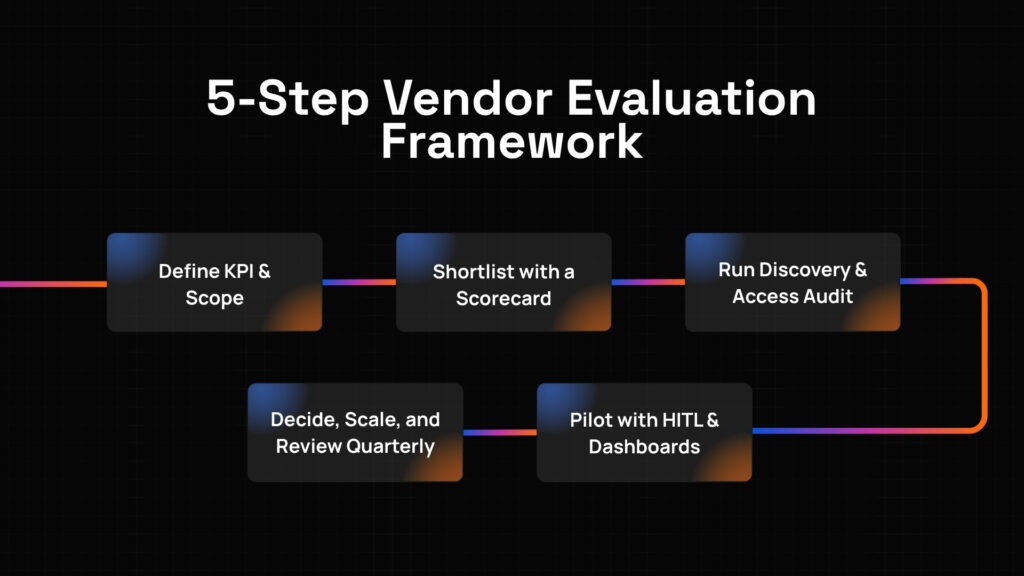
5-Step Vendor Framework for AI Agents
Selecting an AI agent examples vendor should follow a disciplined, structured process that aligns with your organization’s operational goals while accounting for both architectural understanding and component requirements. Instead of focusing solely on impressive demonstrations or autonomy claims, evaluation should weigh how well understanding how do AI agents work translates into measurable outcomes, appropriate integrations, and maintained safety through proper architecture.
1. Define KPI & Scope
Start by identifying specific measurable outcomes with narrow scope enabling quick value proof. Defining concrete targets helps align all stakeholders including operations leadership, process owners, IT infrastructure, and governance teams. Your goal might be improving complex task completion, reducing production incidents, or decreasing handle time, but it must be quantifiable with clear operational impact.
Example: A technology company defined its KPI as “improving complex task success rate by 2X within 90 days while reducing production incidents by 50 percent and maintaining escalation appropriateness above 90 percent.” This metric guided every AI agents discussion, shaped pilot design with clear architectural benchmarks, and became the success measurement. Avoid cross-team agents early.
Pro Tip: Document one primary operational outcome before requesting proposals. Pick one workflow and outcome focusing evaluation enabling clear attribution, and define specific percentage improvement targets with timelines enabling objective go/no-go decisions during pilot evaluation as Gartner shows control requiring systematic approach.
2. Shortlist with Scorecard
Once objectives are clear, move to structured vendor comparison using a weighted scorecard evaluating AI agents providers. This tool allows teams to quantify how well each vendor aligns with priorities including escalation rules, permission controls, log completeness, memory governance, and portability and IP ownership.
Example: One enterprise assigned 30 percent weight to escalation rules assessing handoff quality, 25 percent to permission controls evaluating safety architecture, 20 percent to log completeness ensuring monitoring capability, 15 percent to memory governance, and 10 percent to portability and IP ownership. Compare escalation rules.
Pro Tip: Turn evaluation criteria into numeric scoring so decisions remain defendable beyond subjective demonstration impressions. Score governance higher than features as architectural discipline enables deployment. Ask how failures are handled understanding recovery procedures. Have multiple stakeholders from operations, IT, security, and governance score vendors independently before group discussion to reduce bias.
3. Discovery & Access Audit
Before contracts are signed, a structured discovery phase maps tools and permissions documenting every integration touchpoint and architectural requirement. During this phase, teams validate system connectivity, surface permission gaps, and confirm component capabilities with appropriate access controls. Start in sandbox environments.
Example: A financial services company conducted discovery for AI agents, revealing their systems required OAuth authentication not in standard vendor documentation, their tool permissions were binary requiring granular controls, their memory architecture wasn’t defined requiring storage design, their goal definitions were vague requiring concrete objectives, and their loop logging was manual requiring systematic documentation.
Pro Tip: Vendor should provide loop flow diagrams before proposals validating architecture. Map tools and permissions understanding connectivity requirements. Start in sandbox environments proving capability safely. Use discovery to surface integration limitations, architectural gaps, and component needs before signing when negotiating leverage is highest.
4. Pilot with HITL & Dashboards
A well-designed pilot validates both technology performance and architectural quality under real operational conditions. Instead of autonomous operation, run with human oversight maintaining quality assurance. Incorporating human-in-the-loop review ensures AI agent examples align with operational standards and architectural requirements while building organizational confidence.
Example: A retail company piloted AI agents for workflow automation, running evaluation under real conditions, agent assistance with manager approval maintaining oversight, and dashboard tracking complex task success, production incidents, handle time, and escalation appropriateness, achieving 1.9X success improvement with 48 percent incident reduction and 92 percent escalation appropriateness above 90 percent target. Review error logs weekly as Accenture shows oversight matters.
Pro Tip: Execute pilots with agent assistance where managers approve maintaining oversight, clear success criteria including architectural benchmarks, and measurable KPIs tracked weekly. Agents assist, humans decide establishing appropriate autonomy. Measure task success targeting 2X improvement and incidents targeting 50 percent reduction. Track escalation appropriateness understanding handoff quality. Use pilot to train team on loop understanding and architectural principles.
5. Decide, Scale, & Review Quarterly
After the pilot proves both operational value and architectural quality, use findings to guide the final decision about expanding deliberately validating sustainability and stability. Scaling should be deliberate, adding one new workflow after first proves reliable before comprehensive deployment across multiple processes. Continuous quarterly reviews maintain architectural discipline, ensuring automation adapts as systems, workflows, and business requirements evolve.
Example: A technology company conducted quarterly reviews with its AI agents partner, expanding successful task agent to tool-using and monitoring patterns over 12 months, adding workflows after architectural validation, identifying optimization opportunities improving success by additional 15 percent, and updating guardrails before expanding. Add one new workflow as Microsoft shows loop approach.
Pro Tip: Treat vendor reviews as architectural governance sessions focused on component quality and structural effectiveness, not just performance metrics. Add one new workflow proving reliability before comprehensive deployment. Update guardrails before expanding detecting architectural changes and permission needs. Use quarterly reviews to assess loop execution, memory consistency, goal achievement, and alignment with evolving operational requirements and system capabilities.
Next Steps in Your AI Agents Evaluation
By now, you should have a clear understanding of how do AI agents work and what to prioritize when selecting AI agent examples partners. Bringing these insights together creates a structured evaluation flow that de-risks investment and accelerates deployment while ensuring architectural quality and operational safety.
- Align with operational metrics: Ensure every AI agents feature connects to specific KPIs like task success, incident reduction, or handle time tied to operational impact, not just automation coverage percentages disconnected from actual workflow outcomes and measurable efficiency results.
- Evaluate architectural integration: Confirm that AI agents work smoothly with your operational tools through appropriate permissions, memory systems through governance structures, and goal frameworks through concrete definitions as Microsoft shows loops improving completion requiring comprehensive architecture.
- Focus on component governance: Choose vendors with escalation rules enabling human handoffs, permission controls supporting safety, and comprehensive logging documenting loop execution as Accenture shows human-in-the-loop improving adoption through appropriate judgment.
- Review observability capabilities: Favor partners with step logging capturing loop execution, dashboards tracking architectural metrics, and error reporting surfacing issues as systematic visibility supports continuous optimization identifying improvement opportunities.
- Test with controlled conditions: Always run pilots with human oversight maintaining approval authority, frozen scope on specific workflow, sandbox environments validating safely, and weekly error reviews before production deployment to validate success gains, incident reduction, and operational readiness under real-world conditions with actual workflow complexity.
With these criteria in place, you are better equipped to identify AI agents vendors who not only automate workflows but also complete complex tasks, reduce production incidents, maintain quality, and amplify your team’s capacity to focus on strategic planning requiring architectural expertise that surface capabilities cannot capture.
Vendor Questions to Ask
To make the most informed decision during your AI agents evaluation focusing on how do AI agents work, be sure to ask these essential questions:
- What tools can the agent access today including APIs, databases, and messaging systems defining integration scope?
- How are permissions controlled including read-write progression, access validation, and audit mechanisms ensuring safety?
- What is logged and reviewed including loop steps, tool executions, and memory operations supporting troubleshooting?
- How does escalation work including trigger conditions, handoff procedures, and human notification ensuring appropriate oversight?
- Who owns prompts and logic ensuring operational portability at contract end including export rights for instructions and configurations?
- How do we exit cleanly enabling portability without starting over or losing workflow definitions and historical learnings?
- Can you provide two customer references in similar industries who can discuss architectural quality, incident reduction, and ongoing partnership?
- What are recurring costs beyond license including tool integration maintenance, memory infrastructure, and support fees, and how do expenses scale?
- What happens when loops fail including error handling, rollback procedures, and impact mitigation ensuring continuity?
- How do you support architectural education including training materials, component guidance, and realistic expectation setting preventing disappointment?
Transform Operations with Architectural Understanding
Understanding how do AI agents work is not just theoretical knowledge; it is a strategic operational capability that requires careful component design, appropriate governance, and continuous architectural monitoring. The right understanding brings 2X complex task success through 4-step loops, 50 percent fewer production incidents through permission architecture, and 15 percent handle time reduction through tool integration, while poor architectural clarity creates execution chaos and safety issues that undermine confidence and damage operational reliability.
Ready to transform your operations with clear architectural understanding of how do AI agents work? Book a Free Strategy Call with us to explore the next steps and discover how we can help you design components, validate architecture, and deploy the right AI agents solution for your unique operational environment, integration requirements, governance obligations, and measurable efficiency outcomes.