
The Power of AI Agents: Why Upgrading From Rules Matters
AI agents have evolved from simple automation into mission-critical adaptive systems that define deployment success in modern business operations. Teams implementing professional AI agents are fundamentally transforming how workflow evolution operates, how exception handling executes, and how context management maintains effectiveness without creating rigidity or breaking existing automation. Advanced AI agents now enable complete operational transformation from rules-based automation foundations and deterministic logic to agentic flows with goal-driven execution, enabling operations leaders to focus on strategic initiatives while adaptive intelligence handles systematic variance management that once consumed months during manual exception processing operations.
The data supporting strategic upgrade planning continues to strengthen across operational functions. According to Gartner research, over 70 percent of automation initiatives stall due to rigidity and exception handling, demonstrating that adaptive capability prevents failure as rules-based systems breaking on edge cases, context changes, and human judgment requirements create deployment paralysis when deterministic logic insufficient for handling real-world variance requiring agentic intelligence. McKinsey reports that context-aware systems outperform rules-based automations by 30-50 percent in complex workflows, proving that adaptive execution enables superior results as goal-driven reasoning handling interpretation, multi-step logic, and cross-system context delivers better outcomes than rigid if-then rules creating brittleness.
Why Upgrading to AI Agents Matters for Operational Success
Understanding the transition to AI agents extends beyond simple capability additions; it transforms how operations organizations manage workflow evolution, maintain system reliability, and ensure adaptive execution across all process touchpoints. Rigid automation processes that once created bottlenecks through exploding decision trees, exception dominance, and excessive human review can now be executed with intelligence and precision through AI agents that compound adaptability over time. From preventing the 70 percent initiative stalls through adaptive capability to achieving 30-50 percent better performance through context awareness, strategic AI agents upgrades deliver measurable outcomes that strengthen both deployment success and operational confidence.
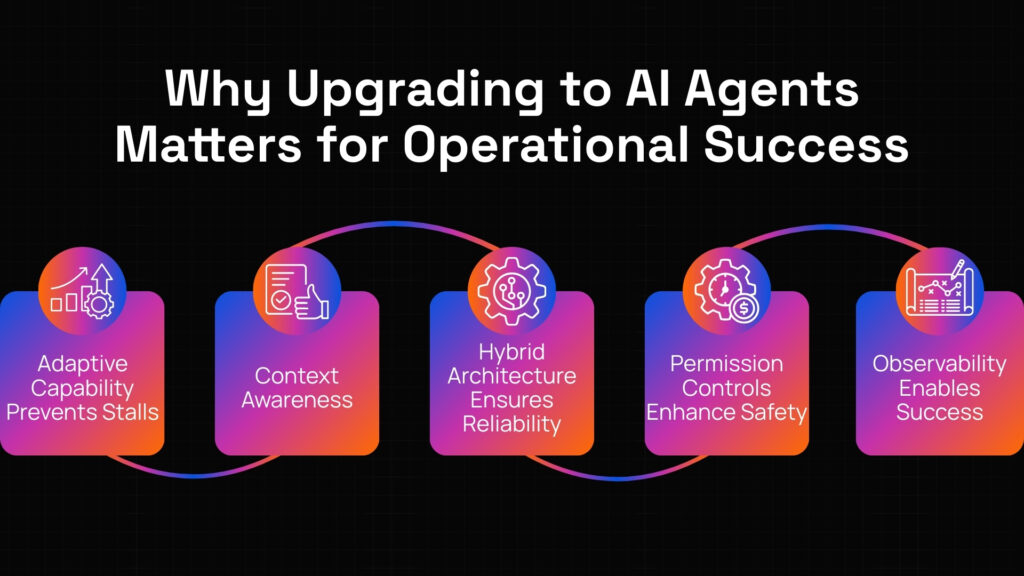
For operations leaders evaluating AI agents strategies, upgrading from rules provides five critical benefits:
- Adaptive Capability Prevents Stalls: Gartner shows that over 70 percent of automation initiatives stall due to rigidity and exception handling, proving that adaptive intelligence prevents failure as rules-based systems breaking on edge cases, context changes, and human judgment requirements create paralysis when deterministic logic insufficient for handling real-world variance, requiring agentic flows managing interpretation and multi-step reasoning preventing brittleness.
- Context Awareness Improves Performance: McKinsey reports that context-aware systems outperform rules-based automations by 30-50 percent in complex workflows, demonstrating that adaptive execution enables superior results as goal-driven reasoning considering context across systems, interpreting nuance, and applying multi-step logic delivers better outcomes than rigid if-then rules creating limitations when variance increases.
- Hybrid Architecture Ensures Reliability: BCG finds that hybrid rule-plus-agent systems deliver the most stable outcomes, validating that blended approach maximizes stability as deterministic logic handling predictable workflows where rules sufficient while agents managing variance where flexibility required creates optimal balance preventing over-autonomy risks from complete agent replacement.
- Permission Controls Enhance Safety: PwC reports that permission scoping reduces agent incidents by over 40 percent, proving that governance controls enhance security as systematic access limitations defining permissions by action, enforcing HITL checkpoints, and maintaining audit trails prevent unauthorized operations while comprehensive boundaries maintain control during adaptive execution.
- Observability Enables Success: Accenture research shows that lack of monitoring is the top cause of agent failure in production, demonstrating that comprehensive logging determines success as traces capturing decision rationale, tool selection, and outcome evaluation enable troubleshooting while observability replaces trust through systematic visibility preventing operational blind spots.
Understanding AI agents is not about replacing rules entirely; it is about establishing adaptive capability systematically through goal-driven execution layered on deterministic foundations, enabling operations professionals to focus capacity on appropriate workflow selection, hybrid architecture design, and controlled transition that handles variance rather than brittle rules creating exceptions.
Understanding AI Agents: Rules-Based Automation vs Agentic Flows
Before launching any AI agents initiative, organizations must thoroughly understand architectural distinctions and capability differences. Rules-based automation differs fundamentally from agentic flows, as execution models create different characteristics. When operations teams recognize distinctions, they accelerate appropriate selection, maintain realistic expectations, and avoid expensive failures from mismatched approaches creating deployment issues.
- Rules-Based Automation Characteristics: If-this-then-that logic following predetermined paths. Deterministic outcomes producing predictable results. Breaks on ambiguity encountering failure when conditions unclear as rigid decision trees work well for predictable workflows but create brittleness when variance increases.
- Agentic Flow Characteristics: Goal-driven execution optimizing toward objectives. Tool selection at runtime choosing appropriate actions dynamically. Human-in-the-loop escalation routing complexity appropriately as adaptive intelligence handles variance rules cannot manage enabling flexible response when context changes.
- Complementary Relationship: AI agents do not replace rules but sit on top of them as hybrid architecture. Deterministic logic handles predictable workflows while agents manage variance creating layered approach as BCG shows hybrid systems delivering most stable outcomes through appropriate tool matching.
Pro Tip: AI agents do not replace rules but sit on top of them creating hybrid architecture. Keep deterministic logic where possible for predictable workflows while using agents where variance, interpretation, and multi-step reasoning required as blended approach maximizes both stability and adaptability.
Understanding AI Agents: What Changes When You Adopt Agents
Before launching any AI agents initiative, organizations must thoroughly understand operational shifts and architectural changes. Adopting AI agents creates three fundamental changes, as execution model transforms workflow management. When operations teams recognize changes, they accelerate appropriate preparation, maintain control discipline, and avoid expensive failures from inadequate adaptation creating operational chaos.
- Control Shifts from Logic to Goals: You define outcomes, not every step as goal-driven execution requires objective clarity. Agents optimize toward targets through flexible path selection rather than following predetermined sequences creating adaptive behavior requiring clear success criteria instead of detailed instructions.
- Tool Use Becomes Dynamic: Agents decide which systems to query or update based on context. Runtime tool selection choosing appropriate actions dynamically rather than fixed sequences as adaptive capability enables flexible response but requires comprehensive permission controls preventing unauthorized operations.
- Monitoring Becomes Mandatory: Observability replaces trust through systematic logging as Accenture shows that lack of monitoring is the top cause of agent failure in production. Comprehensive traces capturing decisions, tools used, and outcomes evaluated enable troubleshooting while transparency supports confidence through visible execution preventing operational blind spots.
Pro Tip: Control shifts from logic to goals requiring outcome definition. Tool use becomes dynamic requiring permission controls. Monitoring becomes mandatory as Accenture emphasizes observability preventing the top cause of agent failure requiring comprehensive logging enabling troubleshooting.
Common Pitfalls When Going Agentic
Understanding AI agents upgrades promises better performance, but poor transition planning and inadequate hybrid design can create instability instead of adaptive success. Many operations organizations make avoidable mistakes during upgrades that delay value realization and erode both system reliability and team trust. To discover proven methodologies tailored for your upgrade requirements and hybrid architecture needs, explore our AI Workflow Automation Services page for detailed AI agents frameworks and real-world transition guidance.
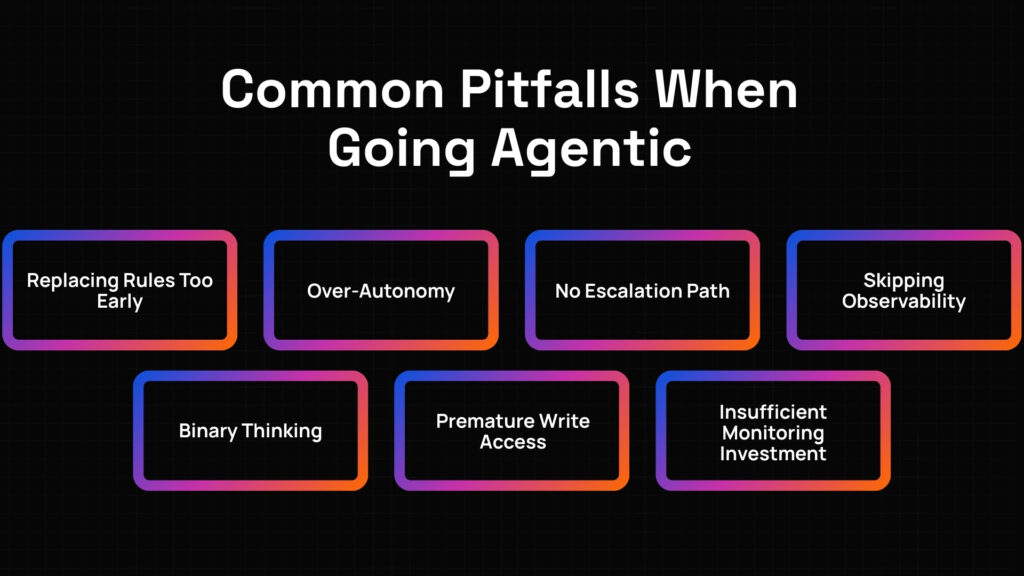
- Replacing Rules Too Early: Removing deterministic logic prematurely creates instability. Keep deterministic logic where possible for predictable workflows, as BCG shows hybrid rule-plus-agent systems delivering most stable outcomes through appropriate tool matching using rules where sufficient while agents handle variance creating balanced architecture.
- Over-Autonomy: Granting excessive independence creates security risk. Gate actions with permissions controlling tool access systematically, as PwC shows permission scoping reducing agent incidents by over 40 percent through comprehensive boundaries preventing unauthorized operations while maintaining necessary flexibility for adaptive execution.
- No Escalation Path: Operating without human oversight creates quality risk. Always design HITL incorporating escalation for complex decisions, as human oversight maintains standards while preventing autonomous errors in ambiguous situations requiring contextual interpretation beyond agent capability ensuring quality control.
- Skipping Observability: Deploying without logging creates operational blind spots. Log everything comprehensively documenting decisions, tool usage, and outcomes, as Accenture shows lack of monitoring causing agent failures requiring systematic visibility enabling troubleshooting when issues arise preventing undiagnosable problems.
- Binary Thinking: Viewing rules and agents as mutually exclusive creates suboptimal architecture. Recognize hybrid value combining deterministic logic for predictable workflows with adaptive agents for variance handling as blended approach maximizes both stability and flexibility.
- Premature Write Access: Granting modification permissions immediately creates corruption risk. Start with read-only capabilities validating agent behavior before enabling writes as controlled permission progression builds confidence through safe validation preventing data integrity issues.
- Insufficient Monitoring Investment: Accepting minimal logging creates troubleshooting challenges. Invest in comprehensive observability including traces and decision logs as systematic visibility enables debugging supporting operational confidence through transparent execution enabling validation.
The Impact of Integration Readiness
Before launching any AI agents initiative, organizations must thoroughly assess their workflow characteristics, system architecture, and governance maturity. Integration readiness evaluates how well existing operational processes, technical infrastructure, and control frameworks can support AI agents upgrade without creating technical debt or execution gaps. When operations teams conduct integration audits in advance, they uncover workflow readiness and architectural limitations early, align stakeholders around transition requirements, and minimize wasted time during upgrade and deployment phases.
Example: A software company preparing for AI agents upgrade mapped their workflow readiness and system preparedness, discovering they were replacing rules too early that required keeping deterministic logic where possible, had over-autonomy risks requiring action gating with permissions, had no escalation path requiring HITL design, and were skipping observability requiring comprehensive logging. Addressing these integration readiness issues before upgrade engagement reduced the overall transition timeline by eight weeks while maintaining system stability.
Pro Tip: Map tools and permissions understanding connectivity requirements comprehensively. Minimize write access early validating agent behavior safely before granting modification capabilities. Use CRM read-only first proving capability as controlled progression builds confidence while preventing security incidents through permission validation.
Evaluating AI Agents ROI
Quantifying the benefits of upgrading to AI agents helps secure executive buy-in and refine future investments in automation technology. Measuring ROI goes beyond simple capability additions; it captures improvements in exception handling, performance enhancement, security improvement, and system stability. Without clear financial modeling during evaluation, AI agents upgrade projects risk becoming expensive transitions that fail to justify ongoing operational expenses and architectural complexity.
Key considerations for financial analysis include:
- Stall Prevention Value: Track deployment success increase when adaptive capability targets higher completion, calculating efficiency as Gartner shows that over 70 percent of automation initiatives stall due to rigidity, requiring agentic flows handling edge cases, context changes, and human judgment requirements preventing brittleness from deterministic logic inadequacy.
- Performance Enhancement Impact: Calculate outcome improvement when context awareness delivers superior results, measuring gains as McKinsey reports that context-aware systems outperform rules-based automations by 30-50 percent in complex workflows through interpretive intelligence, multi-step reasoning, and cross-system context synthesis enabling better decisions.
- Security Improvement Value: Monitor incident reduction when permission scoping prevents violations, quantifying safety as PwC shows that systematic access controls reduce agent incidents by over 40 percent through comprehensive boundaries defining permissions by action, enforcing HITL checkpoints, and maintaining audit trails.
- Stability Enhancement Impact: Track reliability improvement when hybrid architecture maintains consistency, measuring quality as BCG finds that hybrid rule-plus-agent systems deliver most stable outcomes through balanced approach using deterministic logic for predictable workflows while agents handle variance.
- Exception Handling Efficiency: Calculate variance management improvement when agents reduce human review burden, measuring capacity as automated exception handling liberates staff from constant edge case intervention enabling focus on complex situations requiring expertise as reduced escalation demonstrates adaptive capability.
- Total Cost of Ownership: Include upgrade development costs, agent implementation expenses, monitoring infrastructure investment, plus ongoing governance maintenance, permission management, and observability operations in comprehensive analysis. Understand that pricing increases with complexity while hybrid architecture requires realistic cost modeling accounting for both rules maintenance and agent governance.
Gartner shows that over 70 percent of automation initiatives stall due to rigidity and exception handling. McKinsey reports that context-aware systems outperform rules-based automations by 30-50 percent in complex workflows. Accenture research shows that lack of monitoring is the top cause of agent failure in production. BCG finds that hybrid rule-plus-agent systems deliver the most stable outcomes. PwC reports that permission scoping reduces agent incidents by over 40 percent. When every AI agents upgrade maintains deterministic logic for predictable workflows while adding agentic flows for variance, every deployment includes comprehensive observability through traces and decision logs enabling troubleshooting.
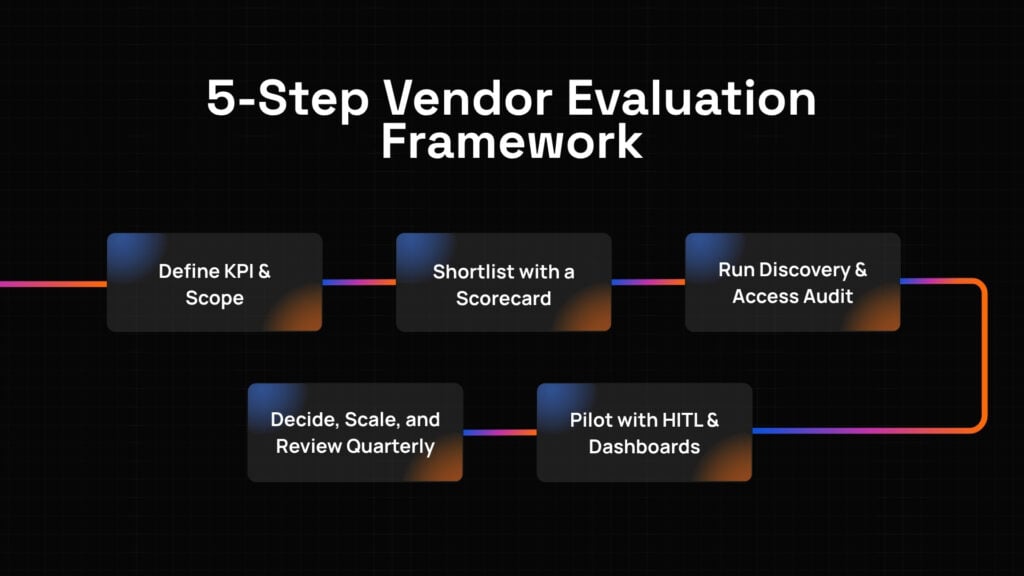
5-Step Framework to Upgrade Safely
Upgrading to AI agents should follow a disciplined, structured process that aligns with your organization’s operational goals while accounting for both adaptive capability requirements and stability maintenance needs. Instead of focusing solely on impressive agent demonstrations or complete rules replacement, transition should weigh how well the hybrid architecture supports measurable outcomes, maintains system reliability, and enables controlled evolution through appropriate governance.
1. Define KPI & Scope
Start by identifying specific measurable outcomes with narrow scope that enables quick value proof. Remember to start with one workflow avoiding cross-functional complexity, as focused deployment proves capability. Defining concrete targets helps align all stakeholders including operations leadership, automation teams, process owners, and governance functions. Your goal might be reducing handling time by 25 percent, improving exception resolution, or decreasing escalation volume, but it must be quantifiable with clear operational impact.
Example: A technology company defined its KPI as “reducing handling time by 25 percent within 90 days while maintaining quality standards above 95 percent and achieving 40 percent fewer security incidents through permission controls.” This metric guided every upgrade discussion, shaped hybrid architecture with clear governance benchmarks, and became the success measurement. They avoided cross-team scope creep maintaining narrow deployment focus.
Pro Tip: Document one primary operational outcome before requesting proposals. Start with one workflow like support triage or sales qualification to enable clear attribution, and define specific percentage improvement targets with timelines that enable objective go/no-go decisions during upgrade evaluation, as concrete goals prevent scope creep from ambitious transformation attempts.
2. Shortlist Vendors with Agent Experience
Once objectives are clear, move to structured vendor comparison emphasizing production experience over demonstrations. Remember to ask how agents fail safely, as error handling determines reliability. This evaluation allows teams to quantify how well each vendor supports safe upgrades including escalation thresholds, permission controls, observability depth, hybrid architecture, and proven methodology.
Example: One enterprise prioritized vendors demonstrating agent experience including asking how agents fail safely to understand error handling, reviewing escalation thresholds to evaluate HITL design, examining permission controls to assess governance, and demanding real production examples to validate claims rather than accepting theoretical capabilities demonstrating operational maturity.
Pro Tip: Turn evaluation criteria into experience validation so upgrade decisions remain defendable beyond impressive demonstrations. Ask how agents fail safely requiring detailed error handling explanation. Demand real production examples including incident reports and resolution procedures. Prioritize vendors with hybrid architecture experience combining rules and agents appropriately as blended systems require specialized expertise.
3. Discovery & Access Audit
Before contracts are signed, a structured discovery phase maps tools and permissions, documenting every integration touchpoint and governance requirement. During this phase, teams validate system connectivity, surface permission requirements, and confirm hybrid capabilities with appropriate safety controls. Start by minimizing write access early to validate behavior safely.
Example: A financial services company conducted discovery for AI agents upgrade, revealing that their systems required comprehensive tool mapping for connectivity, their permissions needed granular controls before agent access, their workflows required hybrid architecture maintaining rules where appropriate, their governance demanded HITL escalation for complex decisions, and their observability needed comprehensive logging for troubleshooting requiring thorough preparation before transition.
Pro Tip: Ensure the vendor provides hybrid architecture diagrams before proposals to validate approach. Map tools and permissions including CRM, support systems, and data sources to understand requirements. Minimize write access early proving agent behavior with read-only access before granting modifications, as PwC shows permission scoping reducing incidents by over 40 percent through controlled validation.
4. Pilot with HITL & Dashboards
A well-designed pilot validates both agent performance and hybrid stability under real operational conditions. Remember that humans stay in the loop maintaining oversight during initial deployment. Instead of full autonomy immediately, run with human review to maintain quality assurance while proving agent capability. Incorporating comprehensive monitoring ensures that observability captures decisions enabling troubleshooting building operational confidence.
Example: A retail company piloted AI agents upgrade with comprehensive oversight, running where humans stayed in the loop reviewing first 100 actions to validate quality. They used dashboards tracking handling time, exception resolution, security incidents, and system stability, achieving 23 percent handling time reduction approaching 25 percent target with 38 percent fewer incidents. They logged decisions, not just outputs, as comprehensive traces enabled troubleshooting.
Pro Tip: Execute pilots reviewing first 100 actions validating quality through human oversight, establishing clear success criteria including stability benchmarks, and tracking measurable KPIs weekly. Humans stay in the loop especially early as trust builds through demonstrated reliability. Measure handling time targeting 25 percent reduction and incidents targeting 40 percent decrease. Log decisions, not just outputs, as Accenture emphasizes comprehensive observability enabling debugging when issues arise.
5. Decide, Scale, & Review Quarterly
After the pilot proves both operational value and hybrid stability, use findings to guide the final decision about controlled expansion, validating sustainability. Remember that autonomy earns trust over time requiring gradual permission increase. Scaling should be deliberate, expanding after consistent accuracy demonstrates reliability before comprehensive deployment. Continuous quarterly reviews maintain governance discipline, ensuring hybrid balance adapts as systems, workflows, and complexity evolve.
Example: A technology company conducted quarterly reviews with its AI agents partner, expanding successful upgrade across additional workflows over 12 months. They expanded after consistent accuracy validating reliability before scaling, identified optimization opportunities improving handling time by additional 10 percent, and reassessed risk as scope grew updating governance as deployment expanded. Autonomy earned trust over time through demonstrated performance.
Pro Tip: Treat vendor reviews as hybrid governance sessions focused on architecture balance and adaptive effectiveness, not just performance metrics. Expand after consistent accuracy proving agent reliability before comprehensive deployment. Reassess risk as scope grows updating governance as deployment expansion changes threat landscape. Use quarterly reviews to assess rule-agent balance, permission appropriateness, observability quality, and alignment with evolving workflow characteristics and operational requirements.
Next Steps in Your AI Agents Upgrade Evaluation
By now, you should have a clear understanding of what to prioritize when upgrading to AI agents. Bringing these insights together creates a structured transition flow that de-risks investment and accelerates adaptive capability while ensuring system stability and operational control.
- Align with operational metrics: Ensure that every upgrade feature connects to specific KPIs like handling time, exception resolution, or incident reduction tied to operational impact, not just adaptive sophistication that is disconnected from actual workflow outcomes and measurable efficiency results.
- Evaluate hybrid architecture: Confirm that upgrades maintain deterministic logic for predictable workflows while adding agentic flows for variance as BCG shows hybrid systems delivering most stable outcomes, requiring appropriate tool matching using rules where sufficient and agents where interpretation, multi-step reasoning, or context needed.
- Focus on controlled transition: Prioritize safe upgrades with permission scoping as PwC shows reducing incidents by over 40 percent, HITL escalation maintaining oversight, and comprehensive observability as Accenture emphasizes preventing the top cause of failure, requiring systematic governance enabling confident delegation through visible execution.
- Review monitoring capabilities: Favor partners with comprehensive traces capturing decisions, decision logs documenting reasoning, and dashboards providing visibility, as lack of monitoring causes agent failures requiring systematic observability enabling troubleshooting supporting operational confidence through transparent execution.
- Test with controlled conditions: Always run pilots with humans in the loop maintaining oversight, frozen scope on specific workflows enabling clear attribution, minimal write access validating safely, and weekly reviews before scaling to validate performance gains, security improvements, and operational readiness under real-world conditions with actual workflow complexity.
With these criteria in place, you are better equipped to identify AI agents upgrade paths that not only add adaptive capability but also maintain system stability, enhance security, deliver measurable performance, and amplify your team’s capacity to focus on strategic planning that requires hybrid architecture expertise that simple rules or pure agents cannot capture.
Vendor Questions to Copy and Paste
To make the most informed decision during your AI agents upgrade evaluation, be sure to ask these essential questions:
- How do agents choose tools, including runtime selection logic, permission enforcement, and dynamic decision-making that determines adaptive execution appropriately?
- Where is human approval required, including escalation triggers, confidence thresholds, and HITL checkpoints that maintain oversight preventing over-autonomy?
- How are failures detected and rolled back, including error identification mechanisms, reversal procedures, and impact mitigation that ensure continuity when agents err?
- What logs and traces are available, including decision documentation, tool usage history, and outcome evaluation that enable troubleshooting as Accenture emphasizes monitoring importance?
- Who owns prompts and policies, ensuring operational portability at contract end, including export rights for agent logic and governance configurations?
- Can you provide two customer references in similar industries who can discuss hybrid architecture stability, upgrade success, and ongoing partnership quality?
- What are the permission control mechanisms, including action-level restrictions, HITL enforcement, and audit trails that prevent incidents as PwC shows reducing problems 40 percent?
- How do you balance rules and agents, including workflow assessment frameworks, hybrid architecture guidance, and transition planning that maintain stability during upgrades?
- What monitoring infrastructure is required, including observability tools, dashboard capabilities, and logging systems that enable comprehensive visibility preventing the top cause of failure?
- How do we validate upgrade readiness, including workflow assessment, system preparation, and governance evaluation that determine appropriate transition timing preventing premature or delayed adoption?
Transform Operations with Strategic AI Agents Upgrades
Upgrading to AI agents is not about replacing rules entirely; it is a strategic hybrid architecture that requires careful balance, appropriate governance, and continuous monitoring. The right approach brings stall prevention avoiding 70 percent rigidity failures, 30-50 percent better performance through context awareness, and 40 percent fewer incidents through permission controls, while poor transitions create instability and security issues that undermine reliability and waste investment.
Ready to transform your operations with strategic AI agents upgrades? Book a Free Strategy Call with us to explore the next steps and discover how we can help you design hybrid architecture, plan safe transitions, and deploy the right AI agents upgrade for your unique workflow characteristics, system requirements, governance obligations, and measurable outcome objectives.