
The Power of AI Automation in Retail: Why Use Case Selection Matters
AI automation in retail has evolved from basic chatbots into intelligent workflow orchestration that defines competitive advantage in modern commerce operations. Retail teams implementing professional AI automation use cases are fundamentally transforming how returns get processed, how inventory stays accurate, and how customer experience improves without creating compliance or integration nightmares. Advanced systems now manage workflows from return authorization and fraud detection to inventory replenishment and omnichannel customer support, enabling retail professionals to focus on strategic decisions while machines handle predictive analytics and coordination that once consumed hours daily.
According to Shopify research, online return rates hit approximately 16.9 percent in 2024, demonstrating substantial reverse-logistics pressure creating margin erosion and operational burden. Investopedia reports some estimates put holiday return volumes at hundreds of billions with fraud accounting for notable share of returns, proving returns eat margin requiring intelligent automation addressing both legitimate returns and fraudulent activity. Reuters indicates large rollouts report big gains with example of one retailer increasing inventory counts eightfold after AI rollout, validating dramatic accuracy improvements from systematic automation. Fortune Business Insights shows retail automation tooling exceeded $24 billion in 2024 and is expanding, demonstrating sustained market validation and investor confidence in retail automation value proposition.
Why AI Automation Use Cases Matter for Retail Operations
AI automation in retail extends beyond simple task automation; it transforms how retail organizations manage reverse logistics, maintain inventory accuracy, and ensure customer satisfaction across all commerce touchpoints. Manual retail processes that once created bottlenecks through time-consuming returns processing, inventory discrepancies, and impossible 24/7 customer support can now be executed with intelligence and precision through AI automation use cases that compound efficiency over time. From reducing manual returns processing time by 50 percent to lowering net return cost by 15 percent, AI automation in retail delivers measurable outcomes that strengthen both operational efficiency and customer experience.
For retail leaders evaluating AI automation use cases strategies, the benefits manifest in five critical ways:
- Returns Processing Acceleration: AI automation in retail handles return authorization, fraud detection, and refund processing cutting manual processing time by 50 percent, with Shopify showing 16.9 percent return rates creating substantial workload as Investopedia notes hundreds of billions in return volumes requiring efficient automation preventing operational overwhelm during peak seasons.
- Inventory Accuracy Transformation: Reuters demonstrates one retailer increased inventory counts eightfold after AI rollout proving dramatic improvements, as AI automation use cases enable continuous monitoring, automated replenishment triggers, and cycle count optimization preventing both stockouts losing sales and overstock tying up working capital through real-time visibility.
- Cost Reduction Achievement: Reducing net return cost by 15 percent through intelligent routing, fraud prevention, and restocking optimization addresses margin pressure, as Investopedia shows fraud accounts for material share requiring detection capabilities while AI automation in retail optimizes reverse logistics minimizing handling expenses.
- Market Growth Validation: Fortune Business Insights shows retail automation tooling exceeded $24 billion in 2024 with expansion proving sustained business cases, demonstrating production-ready maturity as retailers validate returns justifying continued investment in AI chatbot, inventory automation, and customer experience enhancement technologies.
- Customer Experience Measurement: Fullview indicates teams benchmark chatbots by response time, FCR, and CSAT before scaling proving measured approach, as AI automation use cases deliver 24/7 support, instant responses, and consistent service quality while maintaining human escalation for complex situations requiring empathy and creative problem-solving.
AI automation in retail is not about replacing customer service representatives or inventory managers; it is about cutting return headaches, keeping shelves stocked, and making customers happier through workflow optimization enabling retail professionals to focus capacity on strategic merchandising, complex problem resolution, and relationship building that machines cannot replicate effectively.

Key Considerations When Choosing AI Automation in Retail Partners
Selecting the right AI automation use cases requires careful alignment between technology capabilities and retail requirements. The most successful AI automation in retail implementations are built on a foundation of commerce integration, human oversight design, and measurable impact on critical metrics like returns cost, inventory carrying cost, CSAT, and average handle time.
Below are the core factors that should guide every AI automation in retail decision:
- Business Outcomes & KPI Alignment: Every AI automation use cases initiative must connect directly to tangible retail metrics including returns cost reduction, inventory carrying cost optimization, CSAT improvement, or average handle time decrease. Vendors should map features to 1 to 3 specific KPIs with measurement frameworks rather than generic efficiency promises disconnected from actual operational performance.
- Integration with Retail Systems: Effective AI automation in retail depends on seamless connectivity with POS systems, warehouse management systems, ERP platforms, order management systems, phone and webchat channels, plus analytics tools. Need read-write access, event streams, and near-real-time sync for inventory and use-case accuracy as Reuters shows eightfold inventory gains requiring deep integration.
- Security and Compliance: AI automation use cases handle sensitive customer data including payment information, purchase history, and personal identifiers requiring data residency options, encryption at rest and in transit, and PII handling for customer returns. Address security requirements as Shopify shows 16.9 percent return rates involving substantial customer data requiring protection.
- Human-in-the-Loop (HITL) Design: Successful AI automation in retail always includes agent oversight with clear escalation procedures moving to staff and mechanisms allowing agents to correct model outputs. Insist on visible escalation queues and agent edit logs as Fullview shows teams benchmark before scaling requiring quality validation when AI chatbot handles customer interactions.
- Observability and Analytics: Transparency is essential when scaling AI automation in retail across customer touchpoints. A capable vendor provides request traces enabling troubleshooting, model evaluation sets measuring accuracy, comprehensive dashboards tracking both model performance and business metrics, plus one-click rollback for problematic deployments.
- Pricing Transparency and Flexibility: Clarify pricing including transaction assumptions, API call volumes, model evaluations, and integration hours with detailed breakdown. Clarify asset ownership for prompts, datasets, and evaluation sets preventing vendor lock-in as Fortune Business Insights shows $24 billion market requiring sustainable partnerships.
Choosing AI automation in retail partners who understand these requirements ensures your investment delivers sustainable improvements rather than creating integration gaps, vendor lock-in, or compliance vulnerabilities that limit future flexibility when merchandising strategies, customer preferences, or commerce platforms evolve.
Understanding AI Automation Use Cases: 3 Core Retail Workflows
Before launching any AI automation in retail initiative, organizations must thoroughly understand specific workflows demonstrating production readiness. Use case clarity prevents inappropriate implementations creating customer frustration or operational failures. When retail teams identify proven automation candidates, they accelerate value realization, maintain customer experience quality, and avoid expensive failures from automating judgment-heavy work inappropriately.
Returns Processing (Use Case 1): Automate return authorization, fraud detection, and refund processing reducing manual handling time by 50 percent while lowering net return cost by 15 percent. AI automation in retail analyzes return reasons, customer history, and purchase patterns flagging fraud as Investopedia shows material share of returns are fraudulent requiring intelligent detection while legitimate returns get expedited processing improving customer satisfaction.
Inventory Management (Use Case 2): Continuous monitoring, automated replenishment triggers, and cycle count optimization maintain accuracy and availability. AI automation use cases demonstrate real-time visibility and predictive ordering as Reuters shows one retailer increased inventory counts eightfold proving dramatic improvements preventing stockouts losing sales and overstock consuming working capital through intelligent forecasting.
Customer Experience Automation (Use Case 3): AI chatbot and voice agents handle routine inquiries, order status checks, and policy questions providing 24/7 support. AI automation in retail manages high-volume interactions with instant responses as Fullview indicates teams benchmark response time, first-call resolution, and CSAT before scaling ensuring quality meets standards while human agents handle complex issues requiring empathy.
Pro Tip: Start with single product category where returns are heaviest proving value on narrow focused implementation. Example includes reducing manual returns processing time by 50 percent for apparel where Shopify shows 16.9 percent return rates create substantial workload requiring focused excellence demonstrating measurable results before comprehensive deployment across all categories simultaneously.
Understanding AI Automation in Retail KPIs: What to Measure
Before launching any AI automation use cases initiative, organizations must thoroughly define success metrics enabling objective pilot evaluation and ongoing performance monitoring. Key performance indicators provide the measurement framework distinguishing valuable implementations from expensive failures creating operations team skepticism. When retail operations teams establish KPIs in advance, they align stakeholders around clear targets, enable data-driven optimization, and build business cases justifying continued investment through demonstrated value.
- Returns Processing Time: Track duration from return request to resolution measuring efficiency improvements when AI automation in retail handles authorization and fraud detection, targeting 50 percent reduction as Shopify shows 16.9 percent return rates create substantial processing workload requiring automation addressing operational burden.
- Net Return Cost: Calculate comprehensive expenses including handling, restocking, fraud losses, and refund processing measuring cost optimization when intelligent routing and fraud prevention reduce waste, targeting 15 percent reduction as Investopedia shows returns eat margin requiring efficient reverse logistics.
- Inventory Accuracy: Monitor cycle count precision and stock discrepancy rates when continuous monitoring improves visibility, measuring reliability as Reuters demonstrates one retailer achieved eightfold inventory count improvement proving dramatic gains from systematic automation replacing manual spot checks.
- Inventory Carrying Cost: Evaluate working capital tied in stock when predictive ordering optimizes levels, calculating efficiency improvements as AI automation use cases prevent both stockouts and overstock through demand forecasting reducing excess inventory consuming resources.
- Average Handle Time (AHT): Track customer service interaction duration when AI chatbot handles routine inquiries, measuring efficiency as Fullview shows teams benchmark before scaling ensuring automation accelerates resolution without sacrificing quality through appropriate human escalation.
- First-Call Resolution (FCR): Monitor percent of issues resolved in initial contact when automation provides accurate responses, calculating effectiveness as AI automation in retail should maintain or improve FCR rates proving quality preservation not degradation through implementation.
- Customer Satisfaction (CSAT): Evaluate post-interaction satisfaction when AI chatbot and voice agents handle support, ensuring automation maintains experience standards as Fullview indicates teams benchmark CSAT before scaling validating customer acceptance not just operational efficiency.
- Cost Per Interaction: Calculate total support expenses divided by interaction volume when automation handles routine inquiries, measuring financial returns as Fortune Business Insights shows $24 billion market validating substantial investments requiring ROI demonstration.
Pro Tip: Require success gate that includes statistical lift on your KPI during pilot. Run 6 to 8 week evaluation on live but scoped traffic with weekly metric reviews as research shows pilots that include real-traffic evaluation yield clearer go/no-go decisions and faster scale preventing premature deployment based on synthetic testing.
The Impact of Integration Readiness
Before launching any AI automation in retail initiative, organizations must thoroughly assess their commerce platform architecture, data schema quality, and API capability completeness. Integration readiness evaluates how well existing retail systems, customer data assets, and operational procedures can support intelligent automation without creating technical debt or customer experience gaps. When retail operations teams conduct integration audits in advance, they uncover system limitations and data quality issues early, align stakeholders around connectivity requirements, and minimize wasted time during vendor discovery and pilot phases.
Example: An apparel retailer preparing for AI automation use cases mapped their POS and OMS integration, discovering their point-of-sale system used batch file exports requiring daily synchronization creating inventory lag, their order management system lacked real-time event streams preventing instant return authorization, their warehouse management system had inconsistent SKU formats across locations requiring normalization, their customer data platform didn’t capture return reasons preventing fraud pattern analysis, and their data retention policies weren’t documented creating ambiguity about compliance requirements. Addressing these integration readiness issues before vendor engagement reduced the overall project timeline by six weeks.
Pro Tip: Verify data schema, event streams, and sample volume with each vendor during discovery documenting exact connectivity requirements. Include legal and IT in discovery avoiding late surprises regarding PII handling, payment processing, and security attestations. Require access audit as part of discovery as integrations left until later create deployment delays.
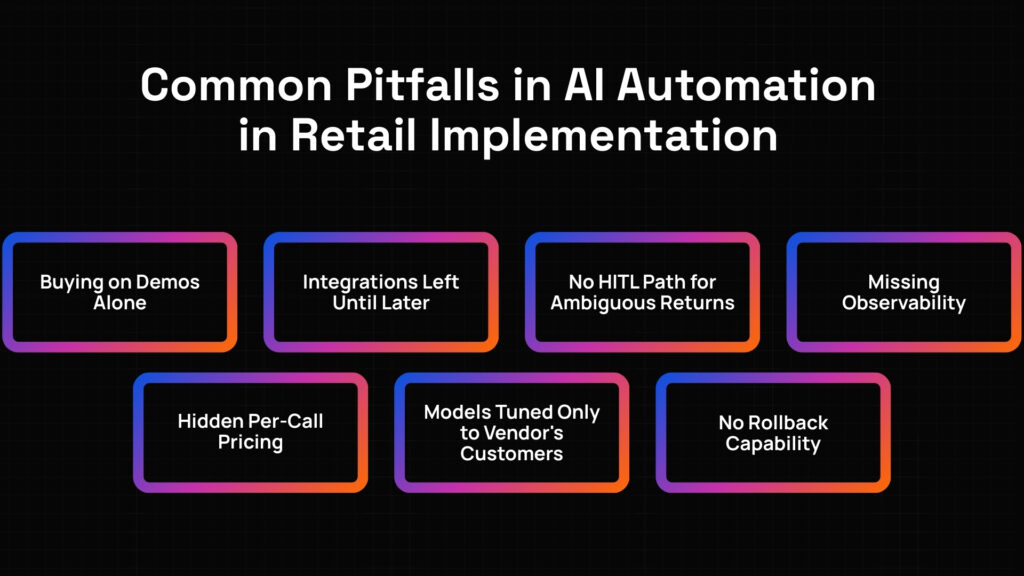
Common Pitfalls in AI Automation in Retail Implementation
AI automation use cases promise efficiency and cost reduction, but poor planning and inadequate integration can create customer frustration instead of experience improvements. Many retail organizations make avoidable mistakes during deployment that delay value realization and erode both team and customer trust. To discover proven methodologies tailored for your retail workflows and commerce requirements, explore our AI Workflow Automation Services page for detailed AI automation in retail frameworks and real-world implementation guidance.
- Buying on Demos Alone: Organizations accepting vendor demonstrations without validation discover production surprises. Ask for on-data pilot using subset of your SKUs proving performance under actual conditions including data quality issues, seasonal variations, and edge cases as Shopify shows 16.9 percent return rates requiring realistic assessment.
- Integrations Left Until Later: Deploying without connectivity planning creates stranded capabilities. Require access audit as part of discovery validating POS, WMS, ERP, and OMS integration feasibility as Reuters shows eightfold inventory gains requiring deep system connectivity not isolated point solutions.
- No HITL Path for Ambiguous Returns: Launching autonomous decision-making for complex cases creates customer dissatisfaction. Insist on visible escalation queues and agent edit logs enabling human review when AI automation in retail encounters unusual situations requiring judgment as Investopedia shows fraud detection needing validation.
- Missing Observability: Deploying without performance visibility prevents troubleshooting and optimization. Demand dashboards for both model performance and business metrics tracking accuracy, cost per interaction, and customer satisfaction as Fullview indicates teams benchmark multiple metrics before scaling.
- Hidden Per-Call Pricing: Accepting pricing without usage transparency creates budget surprises. Request total-cost-of-ownership example for your monthly volumes documenting how costs scale with transaction growth, API usage, and model evaluations preventing situations where production expenses exceed initial projections.
- Models Tuned Only to Vendor’s Customers: Relying on generic training without customization creates poor performance. Validate on your historical data during pilot ensuring AI automation use cases handle your specific return reasons, product categories, and customer behaviors as Fortune Business Insights shows $24 billion market with diverse retail requirements.
- No Rollback Capability: Deploying without reversion mechanisms creates risk when automation degrades customer experience. Describe rollback and incident remediation process for model that degrades performance enabling quick restoration when AI chatbot produces incorrect responses or returns processing fails.
Evaluating AI Automation in Retail ROI
Quantifying the benefits of AI automation use cases helps secure executive buy-in and refine future investments in retail technology. Measuring ROI goes beyond simple time savings; it captures gains in returns processing speed, inventory accuracy, cost reduction, and customer satisfaction. Without clear financial modeling during evaluation, AI automation in retail projects risk becoming unclear implementations that fail to justify ongoing operational expenses and licensing costs.
Key considerations for financial analysis include:
- Returns Processing Efficiency: Calculate time saved when AI automation in retail reduces manual processing by 50 percent, measuring operational capacity release enabling staff focus on complex cases and customer relationships as Shopify shows 16.9 percent return rates create substantial workload requiring efficiency improvements.
- Returns Cost Reduction: Track 15 percent net return cost decrease when intelligent routing, fraud prevention, and restocking optimization reduce expenses, calculating margin protection as Investopedia reports hundreds of billions in return volumes with fraud accounting for material share requiring detection and prevention capabilities.
- Inventory Accuracy Gains: Measure working capital optimization when eightfold inventory count improvement reduces both stockouts and overstock, calculating revenue capture from availability plus capital release from excess reduction as Reuters demonstrates dramatic improvements from systematic automation.
- Customer Support Efficiency: Track cost per interaction reduction when AI chatbot handles routine inquiries at fraction of human agent cost, measuring operational savings as Fullview shows teams benchmark multiple metrics proving financial returns from 24/7 automated support supplementing human capacity.
- Customer Experience Maintenance: Monitor CSAT preservation or improvement ensuring automation maintains quality, as Fullview indicates teams benchmark satisfaction before scaling validating customer acceptance. Calculate lifetime value impact from satisfaction improvements or declines attributing to automation quality.
- Total Cost of Ownership: Include licensing fees, integration expenses, API usage costs, model training, and ongoing retraining in comprehensive analysis. Understand pricing scales with transaction volume, interaction frequency, and data complexity as Fortune Business Insights shows $24 billion market with varied cost structures.
Shopify shows online return rates hit approximately 16.9 percent in 2024. Investopedia reports hundreds of billions in return volumes with fraud notable share. Reuters indicates one retailer increased inventory counts eightfold after AI rollout. Fortune Business Insights shows retail automation tooling exceeded $24 billion in 2024. Fullview notes teams benchmark chatbots by response time, FCR, and CSAT before scaling. When every AI automation in retail interaction logs decision logic, escalation triggers, and customer outcomes, every returns authorization validates against fraud patterns before processing, and every quarterly review assesses model drift and KPI alignment, organizations build trusted retail operations that scale without sacrificing customer experience, inventory accuracy, or operational efficiency.
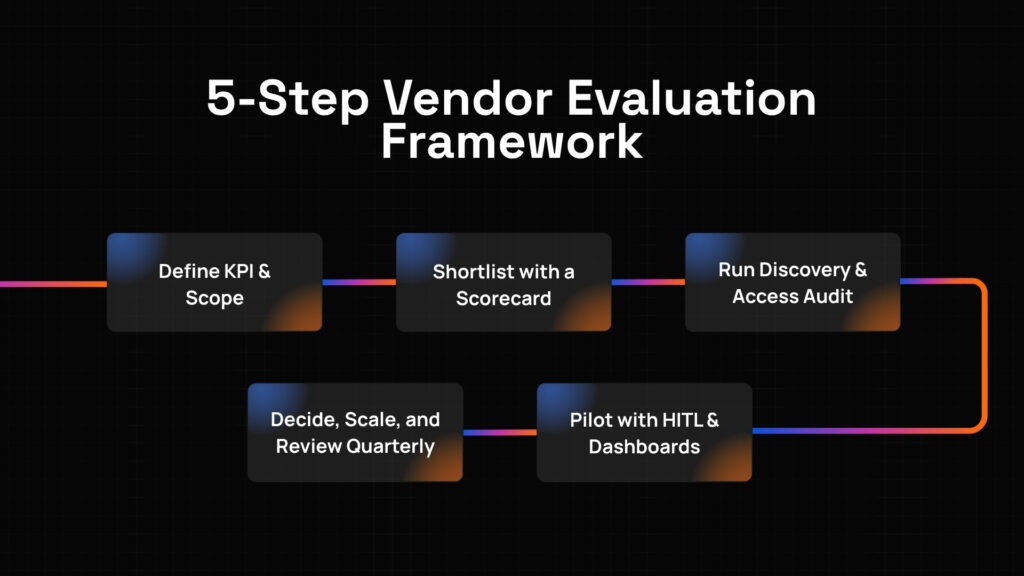
5-Step Vendor Framework for AI Automation in Retail
Selecting an AI automation use cases vendor should follow a disciplined, structured process that aligns with your organization’s retail goals while accounting for both technological depth and customer experience requirements. Instead of focusing solely on impressive demonstrations or efficiency claims, evaluation should weigh how well the AI automation in retail solution supports measurable outcomes, integrates with existing systems, and maintains quality through appropriate governance.
1. Define KPI & Scope
Start by identifying specific measurable outcomes with narrow scope enabling quick operational validation. Defining concrete targets helps align all stakeholders including operations leadership, customer service, inventory management, and IT infrastructure. Your goal might be reducing manual returns processing time by 50 percent and lowering net return cost by 15 percent, improving inventory accuracy, or decreasing customer service AHT, but it must be quantifiable with clear retail impact.
Example: A fashion retailer defined its KPI as “reducing manual returns processing time by 50 percent and lowering net return cost by 15 percent for apparel category within 90 days while maintaining CSAT above 4.0 out of 5.0 and fraud detection rate above 85 percent.” This metric guided every AI automation in retail discussion, shaped pilot design with clear operational benchmarks, and became the success measurement. Start with single product category where returns are heaviest.
Pro Tip: Document one to three primary retail outcomes before requesting proposals. Focus on returns processing time, net return cost, or inventory carrying cost tied to operational efficiency rather than vanity metrics like total transactions processed, and define specific percentage improvement targets with timelines enabling objective go/no-go decisions during pilot evaluation as Shopify shows 16.9 percent return rates creating measurable burden.
2. Shortlist with a Scorecard
Once objectives are clear, move to structured vendor comparison using a weighted scorecard evaluating AI automation use cases providers. This tool allows teams to quantify how well each vendor aligns with priorities including integration depth, security and compliance, HITL design, observability, references, and pricing transparency.
Example: One enterprise assigned 25 percent weight to integration depth with POS, WMS, ERP, and OMS systems, 20 percent to security and compliance meeting PCI-DSS requirements, 15 percent each to HITL design and observability capabilities, 15 percent to references and case signals, and 10 percent to pricing transparency and exit portability. Weight items where you can’t compromise like payment and ERP write access.
Pro Tip: Turn evaluation criteria into numeric scoring so decisions remain defendable beyond subjective demonstration impressions. Score integration, security, HITL, observability, references, and pricing clarity on 0 to 5 scale. Weight appropriately as Reuters shows eightfold inventory gains and Fortune Business Insights indicates $24 billion market requiring proven approaches. Have multiple stakeholders from operations, IT, and customer service score vendors independently before group discussion to reduce bias.
3. Run Discovery & Access Audit
Before contracts are signed, a structured discovery phase verifies data schema, event streams, and sample volume with each vendor documenting every integration touchpoint and compliance requirement. During this phase, teams validate connector capabilities, surface data quality gaps, and confirm security controls with appropriate permissions. Include legal and IT in discovery.
Example: A home goods retailer conducted discovery for AI automation in retail, revealing their POS system required custom API authentication not in standard vendor documentation, their WMS used inconsistent SKU formats across warehouses preventing automated matching, their OMS lacked real-time event streams requiring polling workarounds, their payment processor had security requirements not addressed in initial proposals, and their customer data retention policies varied by jurisdiction creating compliance complexity.
Pro Tip: Verify data schema, event streams, and sample volume with each vendor before proposals documenting exact connectivity requirements. Include legal and IT in discovery avoiding late surprises regarding PII handling, payment processing, and data residency. Require access audit as part of discovery as integrations left until later create deployment delays and cost overruns.
4. Pilot with HITL & Dashboards
A well-designed pilot validates both technology performance and customer experience maintenance under real retail conditions. Instead of full-scale deployment, run 6 to 8 week pilot on live but scoped traffic with weekly metric reviews maintaining agent oversight for quality assurance. Incorporating human-in-the-loop review ensures AI automation in retail outcomes align with service standards and customer satisfaction requirements while building organizational confidence.
Example: An electronics retailer piloted AI automation use cases for returns processing, running 8-week evaluation with controlled deployment on one product category, agent review for high-value returns and fraud cases, and dashboard tracking processing time, net cost, fraud detection, and CSAT, achieving 48 percent time reduction with 14 percent cost decrease plus 4.3 CSAT above 4.0 target. Require success gate that includes statistical lift on your KPI as research shows real-traffic evaluation yields clearer decisions.
Pro Tip: Execute pilots with frozen scope covering specific product category, clear success criteria including customer experience benchmarks, and measurable KPIs tracked weekly. Run 6 to 8 week pilot on live but scoped traffic establishing statistical significance. Measure returns processing time targeting 50 percent reduction and net cost targeting 15 percent decrease. Track fraud detection rate and CSAT ensuring quality maintenance. Use pilot to train agents on escalation procedures and model override capabilities.
5. Decide, Scale, and Review Quarterly
After the pilot proves both operational value and customer experience maintenance, use findings to guide the final decision about rolling out category-by-category validating sustainability and stability. Scaling should be deliberate, expanding only after demonstrating approach maintains quality across representative product categories and customer segments. Continuous quarterly reviews maintain operational discipline, ensuring automation adapts as product mix, return patterns, and customer preferences evolve.
Example: A beauty retailer conducted quarterly reviews with its AI automation in retail partner, expanding successful apparel returns automation to cosmetics and accessories over 12 months, rolling out category-by-category after validation, identifying optimization opportunities reducing net cost by additional 3 percent, and reviewing quarterly for model drift, cost-per-interaction, and KPI alignment as Fullview shows teams benchmark before scaling. Keep quarterly review for drift and alignment.
Pro Tip: Treat vendor reviews as operational governance sessions focused on customer experience and cost efficiency, not just performance metrics. Roll out category-by-category proving reliability before comprehensive deployment. Review model drift detecting pattern changes, cost per interaction tracking efficiency trends, and KPI alignment ensuring business value. Use quarterly reviews to assess fraud detection accuracy, customer satisfaction trends, and alignment with evolving product mix and seasonal patterns.
Next Steps in Your AI Automation in Retail Evaluation
By now, you should have a clear understanding of what to prioritize when selecting AI automation use cases partners for retail. Bringing these insights together creates a structured evaluation flow that de-risks investment and accelerates deployment while ensuring customer experience and operational efficiency.
- Align with retail metrics: Ensure every AI automation in retail feature connects to specific KPIs like returns processing time, net return cost, inventory carrying cost, or CSAT tied to operational efficiency, not just automation coverage percentages disconnected from actual business outcomes and measurable results.
- Evaluate commerce integration: Confirm that AI automation use cases work smoothly with your POS, WMS, ERP, OMS, and customer service platforms through bi-directional sync and event streams enabling near-real-time accuracy as Reuters shows eightfold inventory gains requiring deep connectivity.
- Focus on human oversight: Choose vendors with visible escalation queues moving ambiguous cases to staff, agent edit logs enabling corrections, and transparent decision logic as Investopedia shows fraud detection requiring validation and Fullview indicates teams benchmark quality before scaling.
- Review observability capabilities: Favor partners with request traces enabling troubleshooting, model evaluation sets measuring accuracy, dashboards tracking both model performance and business metrics, and one-click rollback allowing quick reversion when automation degrades customer experience.
- Test with controlled pilots: Always run 6 to 8 week pilots on live but scoped traffic, weekly metric reviews, frozen scope on one category, and success gates including statistical lift before full deployment to validate processing improvements, cost reductions, and operational readiness under real-world retail conditions with actual customer complexity.
With these criteria in place, you are better equipped to identify AI automation in retail vendors who not only automate workflows but also reduce returns costs, improve inventory accuracy, maintain customer satisfaction, and amplify your team’s capacity to focus on strategic merchandising and complex problem resolution requiring creativity that machines cannot replicate.
Vendor Questions to Ask
To make the most informed decision during your AI automation in retail evaluation, be sure to ask these essential questions:
- How do you integrate with POS, WMS, ERP, and OMS systems, and do you support bi-directional sync with event streams for near-real-time accuracy?
- Can you run pilot on our historical returns and inventory data, and what access do you need including API scopes and data formats?
- What are your security certifications and data residency options including PCI-DSS compliance and encryption standards for payment and customer data?
- How do you handle human override and escalation including visible queues and agent edit capabilities, and is there comprehensive audit log?
- Which observability tools, dashboards, and evaluation sets do you provide tracking both model performance and business metrics?
- How do you measure ROI and which retail KPIs can you tie to outcomes including returns cost, inventory accuracy, and customer satisfaction?
- What assets will we own at end of engagement including prompts, models, evaluation sets, and transformation code ensuring operational portability?
- Describe rollback and incident remediation process for model that degrades performance enabling quick restoration when automation fails?
- Can you provide two anonymized retail case studies with similar SKU complexity demonstrating measurable before-after improvements?
- What are recurring costs beyond license including per-call pricing, API usage, model retraining, and integration maintenance fees?
Transform Retail Operations with AI Automation in Retail
AI automation in retail is not just a technological investment; it is a strategic operational capability that requires careful planning, appropriate integration, and continuous performance monitoring. The right implementation brings 50 percent faster returns processing, 15 percent lower costs, and improved customer experience across 3 core workflows, while poor execution creates customer frustration and integration failures that undermine confidence and waste investment.
Ready to transform your retail operations with AI automation in retail? Book a Free Strategy Call with us to explore the next steps and discover how we can help you scope pilots, validate integration readiness, and deploy the right AI automation use cases solution for your unique commerce platform, operational workflows, product categories, and measurable business outcomes.