
The Power of Understanding What Is the Difference Between AI and Automation
What is the difference between AI and automation represents one of the most practical decisions operations leaders and founders can make when optimizing workflows and selecting technology partners. Organizations evaluating automation strategies are fundamentally choosing between rule-based systems executing predefined tasks and intelligent systems that learn, adapt, and make context-aware decisions. Understanding AI automation vs RPA and what is the difference between AI and automation enables businesses to map each workflow to the right technology class, avoiding overspending on over-engineered solutions or mis-scoping with brittle systems that break when processes evolve.
The data supporting strategic technology selection continues to strengthen across industries. According to research from arXiv and industry analysis, up to 36 percent of occupations are already using AI for at least a quarter of their tasks, demonstrating mainstream adoption beyond experimental pilots. Industry commentary notes that AI’s learning and decision-making layer is what differentiates it from standard automation, as traditional systems execute predefined rules while AI adapts to new patterns and contexts.Understanding AI and RPA together creates opportunities for hybrid approaches where automation handles predictable execution while AI addresses exceptions, unstructured data, and decision-making requiring judgment.
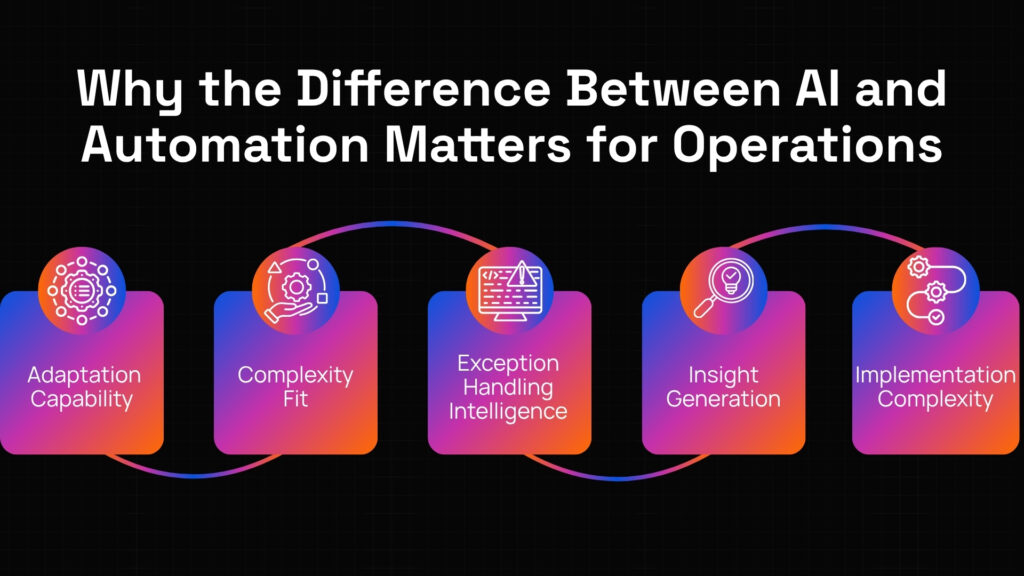
Why the Difference Between AI and Automation Matters for Operations
Understanding what is the difference between AI and automation transforms how organizations approach workflow optimization, technology selection, and value realization. Manual decision-making about technology application that once created bottlenecks through incorrect matching, over-engineered solutions, or brittle implementations can now be executed strategically through AI process automation or traditional automation depending on task characteristics. From deploying standard automation for invoice data entry to implementing AI for customer inquiry classification, selecting appropriate technology delivers measurable outcomes that strengthen both operational efficiency and strategic capacity.
For operations leaders evaluating what is the difference between AI and automation strategies, the key distinctions manifest in five critical ways:
- Learning and Adaptation Capability: Traditional automation executes predefined rules consistently without variation, while AI learns from data patterns and adapts to new scenarios, with industry noting AI’s learning and decision-making layer as the fundamental differentiator enabling systems to improve over time rather than requiring developer updates.
- Complexity Fit: Standard automation excels for repetitive, rule-based tasks with structured inputs and predictable paths yielding fast operational gains, while AI process automation handles unstructured data, variable scenarios, and context-aware decision-making that traditional systems cannot address effectively.
- Exception Handling Intelligence: Rule-based automation routes all exceptions to humans uniformly or breaks on unexpected inputs, while AI and RPA hybrid approaches apply confidence thresholds and learned patterns to resolve some exceptions autonomously and escalate others appropriately based on complexity and risk assessment.
- Insight Generation: Traditional automation executes tasks without generating strategic insights, while AI analyzes patterns across data providing recommendations, predictions, and optimization opportunities that inform business strategy beyond pure execution efficiency as the 36 percent of occupations using AI leverage these analytical capabilities.
- Implementation Complexity: Standard automation typically offers faster deployment and lower upfront costs for simple workflows, while AI process automation requires more investment in data preparation, model training, and change management but delivers greater long-term value for complex processes requiring adaptability and continuous improvement.
What is the difference between AI and automation is not about one technology replacing the other; it is about strategic selection matching technology to workflow characteristics, often combining automation first for predictable tasks with AI-augmented automation where adaptability, learning, and context awareness create competitive advantage.
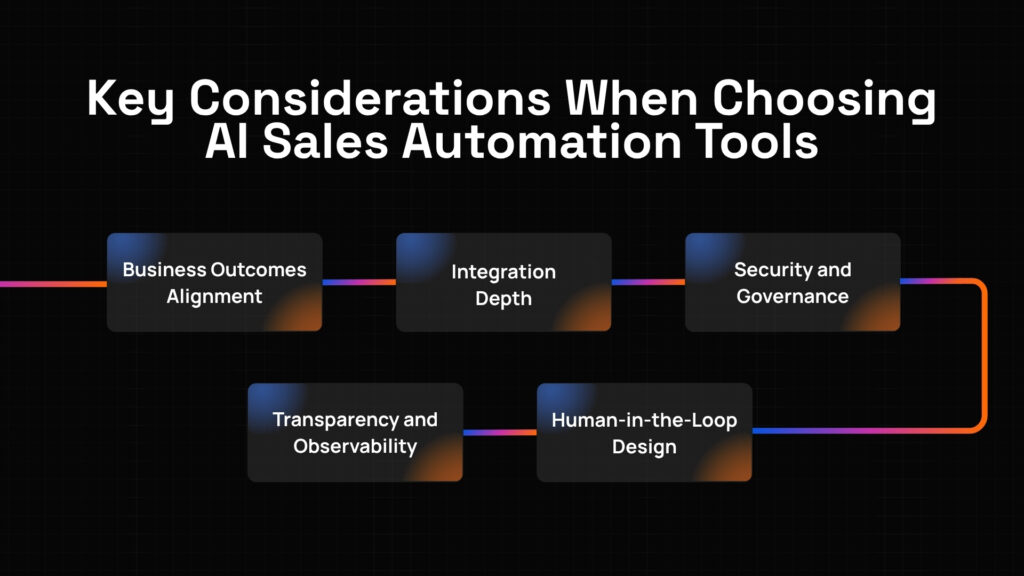
Key Considerations When Choosing AI Automation vs RPA Partners
Selecting the right approach for what is the difference between AI and automation requires careful alignment between technology capabilities and workflow requirements. The most successful implementations are built on a foundation of transparency, appropriate complexity matching, and measurable impact on critical metrics like time to resolution, cost per ticket, and error rates.
Below are the core factors that should guide every decision about what is the difference between AI and automation:
- Business Outcomes & KPI Alignment: Every AI process automation or traditional automation initiative must connect directly to tangible operational metrics including time to resolution reduction, cost per ticket decrease, conversion rate improvement, or error rate decline. Vendors should tie solutions to specific metrics you care about with measurement frameworks, not vague efficiency promises disconnected from business outcomes.
- Integration with Existing Systems: Effective AI and RPA depend on seamless connectivity with your core systems including CRM, help desk platforms, ERP, phone systems, and treasury management systems. Look for read-write access enabling bi-directional data flow plus event triggers so systems can react to business events in real-time rather than polling or batch processing.
- Security and Governance: Both traditional automation and AI process automation handle sensitive business data requiring strict controls. Confirm how data flows are managed, what compliance frameworks apply, where data residency occurs, and how comprehensive audit trails support governance reviews and regulatory requirements.
- Human-in-the-Loop (HITL) Design: Even advanced AI systems need human oversight for quality assurance and exception handling. Ensure clear definition of how and when human intervention happens including confidence thresholds triggering escalation, what context humans receive, and how decisions get logged for continuous improvement.
- Observability and Analytics: Transparency is essential when scaling AI automation vs RPA across process volume. A capable vendor provides comprehensive capabilities to trace actions showing decision logic, view dashboards tracking performance metrics, evaluate model accuracy over time, and rollback changes when updates degrade outcomes.
- Pricing Transparency and Flexibility: Demand clarity on pricing ranges, underlying assumptions, and license models without requesting detailed quotes yet. Confirm ownership of assets created including trained models, prompts, policies, and evaluation data ensuring intellectual property developed during implementation belongs to your organization.
Choosing partners who understand what is the difference between AI and automation ensures your investment matches technology to task characteristics appropriately rather than applying AI to simple rule-based workflows or deploying brittle automation on complex adaptive processes.
The Impact of Integration Readiness
Before launching any initiative addressing what is the difference between AI and automation, organizations must thoroughly assess their data quality, operations maturity, and workflow documentation. Integration readiness evaluates how well existing processes, data sources, and technical infrastructure can support intelligent systems without creating chaos or poor outcomes. When operations teams conduct integration audits in advance, they uncover data gaps and process instability early, align IT and business stakeholders around readiness requirements, and minimize wasted time during vendor discovery and pilot phases.
Example: A customer support organization preparing for AI process automation mapped their ticket resolution workflows, auditing data readiness and discovering 40 percent of tickets lacked proper categorization required for AI training, their knowledge base used inconsistent terminology preventing effective retrieval, and their escalation procedures mixed simple routing rules with judgment-based decisions. This analysis revealed they needed data cleanup before AI implementation and identified rule-based workflows ready for traditional automation immediately.
Pro Tip: Audit data readiness before vendor demonstrations. Check what data vendors need, what access rights you’ll grant, and how workflows will integrate with existing systems. Ask for live access to similar system implementations, not just screenshots or demonstrations, to validate capabilities under realistic conditions matching your operational complexity.
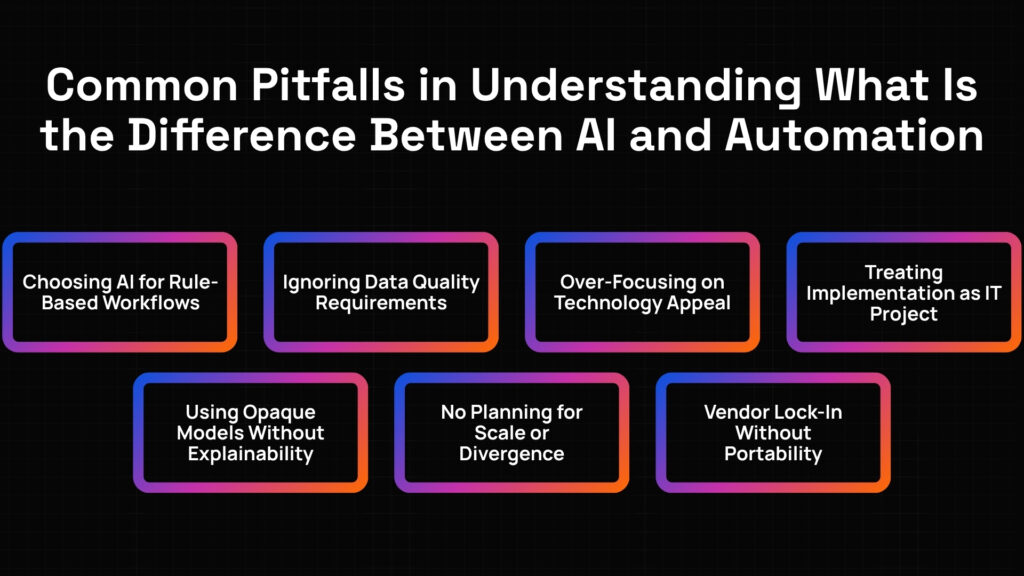
Common Pitfalls in Understanding What Is the Difference Between AI and Automation
Technology selection promises efficiency and insight generation, but poor matching and inadequate planning can create implementation failures instead of operational improvements. Many organizations make avoidable mistakes during deployment that delay value realization and erode both team and leadership trust. To discover proven methodologies tailored for your workflow requirements and technology selection, explore our AI Workflow Automation Services page for detailed frameworks addressing what is the difference between AI and automation with real-world implementation guidance.
- Choosing AI for Rule-Based Workflows: Some organizations deploy AI process automation on workflows that are purely rule-based. Start with standard automation for predictable tasks and evolve to AI later when adaptability or learning becomes necessary, avoiding over-engineering that increases costs without delivering proportional value.
- Ignoring Data Quality Requirements: Organizations assuming their data is automation-ready discover gaps during implementation. Audit data readiness before vendor evaluations including completeness, consistency, and accuracy, as AI and RPA both depend on quality inputs but AI requires more extensive training data than rule-based systems.
- Over-Focusing on Technology Appeal: Teams selecting “cool tech” without business justification create impressive implementations with unclear value. Always ask what KPI moves when this goes live including specific percentage improvements in time, cost, or quality metrics that justify investment and organizational change.
- Treating Implementation as IT Project: Organizations limiting involvement to technical teams face adoption failures. Include operations stakeholders and change management early ensuring frontline users understand benefits, workflows align with actual work patterns, and resistance gets addressed proactively rather than after deployment.
- Using Opaque Models Without Explainability: Deploying AI process automation without transparency creates trust issues and compliance risks. Demand explainability and human audit points showing how decisions get made, what data influenced outcomes, and when confidence drops requiring human review.
- No Planning for Scale or Divergence: Organizations treating pilots as endpoints face challenges during expansion. Build with observability and rollback capabilities built in from day one enabling graceful handling of performance degradation, model drift, or changing business requirements as operations evolve.
- Vendor Lock-In Without Portability: Contracts lacking export provisions create dependency preventing future flexibility. Insist on ownership and extractable logic from day one including trained models, prompts, policies, evaluation data, and workflow diagrams ensuring you can switch providers without losing operational capability.
Evaluating the ROI of AI Process Automation vs Traditional Automation
Quantifying the benefits of addressing what is the difference between AI and automation helps secure executive buy-in and refine future investments in operational technology. Measuring ROI goes beyond simple task completion; it captures gains in resolution time, cost efficiency, accuracy improvement, and strategic insight generation. Without clear metrics during evaluation, technology projects risk becoming unclear implementations that fail to justify ongoing operational expenses and licensing costs.
Key metrics to monitor include:
- Time to Resolution Improvement: Track reduction in end-to-end process duration when automation handles repetitive execution or AI provides intelligent routing and decision support, targeting specific percentage improvements like 25 percent reduction in first-contact resolution time defined in pilot success criteria.
- Cost Per Transaction Reduction: Measure decreases in operational costs when technology eliminates manual work, calculating unit economics improvements demonstrating financial returns beyond productivity gains as the 36 percent of occupations using AI validate through measurable efficiency improvements.
- Error Rate Reduction: Evaluate quality improvements when systems apply consistent rules or learned patterns, targeting thresholds like 2 percent or lower error rates with throughput improvements of 15 percent or greater demonstrating both efficiency and accuracy gains simultaneously.
- Insight Generation Value: Assess strategic benefits from AI’s learning and decision-making layer that industry notes as fundamental differentiator, measuring value of predictions, pattern identification, and optimization recommendations that inform business strategy beyond pure execution efficiency.
- Adaptability and Resilience: Review improvements in exception handling and process evolution when AI process automation adapts to new scenarios versus brittle traditional automation requiring developer updates, calculating total cost of ownership including maintenance overhead over time.
- Adoption and Scale Progress: Calculate momentum as understanding of what is the difference between AI and automation drives appropriate technology selection, measuring implementation maturity as organizations deploy automation first for predictable tasks while AI-augmented automation handles adaptability and learning requirements.
Research shows 36 percent of occupations use AI for at least a quarter of tasks. Industry notes AI’s learning and decision-making layer as key differentiator. When every AI and RPA interaction logs decision logic, confidence scores, escalation triggers, and outcomes, every workflow change maintains version history with rollback capabilities, and every process includes appropriate human oversight for quality assurance, organizations build trusted operations that scale without sacrificing quality or creating governance vulnerabilities.
5-Step Vendor Evaluation Framework for What Is the Difference Between AI and Automation
Selecting an automation or AI vendor should follow a disciplined, structured process that aligns with your organization’s operational goals while accounting for both technological depth and long-term partnership potential. Instead of focusing solely on impressive demonstrations or technology appeal, evaluation should weigh how well the vendor’s approach supports measurable outcomes, integrates with existing systems, and matches technology to workflow characteristics appropriately.
1. Define KPI & Scope
Start by picking one measurable outcome rather than attempting comprehensive transformation simultaneously. Defining specific targets helps align all stakeholders including operations leadership, IT departments, process owners, and frontline teams. Your goal might be reducing first-contact resolution time by 25 percent in your support center, improving conversion rates, or decreasing error rates, but it must be quantifiable. This clarity becomes the foundation for understanding AI automation vs RPA requirements for your specific use case.
Example: A customer service organization defined its KPI as “reducing first-contact resolution time by 25 percent within 90 days while maintaining customer satisfaction above 4.0 out of 5.0.” This metric guided technology selection determining which workflows suited traditional automation versus requiring AI process automation, shaped pilot design, and became the benchmark for success measurement. Pick one measurable outcome and cap scope to subset like 100 agents maximum.
Pro Tip: Document one primary operational outcome before requesting proposals. Focus on time to resolution, cost per ticket, or error rate tied to financial impact rather than vanity metrics like tasks automated, and define specific percentage improvement targets that enable objective go/no-go decisions during pilot evaluation.
2. Shortlist with a Scorecard
Once objectives are clear, move to structured vendor comparison using a weighted scorecard evaluating providers addressing what is the difference between AI and automation. This tool allows teams to quantify how well each vendor aligns with priorities including integration depth, observability capabilities, human-in-the-loop design, governance frameworks, and data portability. Create simple table using criteria and score each vendor 1 to 5.
Example: One enterprise assigned equal weight across evaluation criteria scoring vendors on integration depth with core systems, security and governance controls, human oversight design, observability tooling, delivery methodology, reference validation, pricing transparency, and exit portability, enabling objective comparison beyond subjective impressions from demonstrations. Keep vendor-neutral during initial scoring avoiding bias from brand recognition.
Pro Tip: Turn evaluation criteria into numeric scoring so decisions remain defendable. Weight factors reflecting your priorities with integration, KPI alignment, and governance typically receiving highest emphasis. Have multiple stakeholders score independently before group discussion to reduce bias from impressive presentations or sales relationships.
3. Run Discovery & Access Audit
Before contracts are signed, a structured discovery phase checks what data vendors need, what rights you’ll grant, and how workflows will integrate with existing systems. During this phase, teams validate integration assumptions, surface data quality gaps requiring remediation, and confirm security controls with appropriate permissions. Ask for live access to similar system implementations, not just screenshots, to validate realistic capabilities.
Example: A financial services company conducted discovery for AI process automation revealing their document classification workflow had 65 percent structured documents suitable for traditional automation and 35 percent requiring AI for unstructured extraction. Vendor access audit surfaced that their content management system lacked modern APIs, their training data contained inconsistent labels, and their escalation procedures weren’t documented preventing appropriate workflow design.
Pro Tip: Map what data vendors need, access rights required, and integration touchpoints with existing systems. Check data readiness including completeness, consistency, and labeling quality before demonstrations. Ask for live access to similar implementations showing actual performance under realistic conditions matching your operational complexity and volume.
4. Pilot with HITL & Dashboards
A well-designed pilot validates both technology performance and operational readiness under real conditions. Instead of full-scale deployment, roll out to shaded subset like 10 percent of cases with human review and audit dashboards tracking performance. Incorporating human-in-the-loop oversight ensures AI automation vs RPA outcomes align with quality standards and business requirements while building organizational confidence.
Example: A logistics company piloted document routing with AI classification, logging AI decisions plus human overrides for quality assessment, running 8-week evaluation with 10 percent of volume and achieving 18 percent throughput improvement with 1.8 percent error rate below 2 percent target. Agree success criteria in advance including specific error rate thresholds and throughput improvement targets enabling objective evaluation.
Pro Tip: Execute pilots with frozen scope covering specific process subset, clear success criteria comparing to baseline metrics, and measurable KPIs tracked weekly. Roll out to shaded subset with human review for quality assurance. Track both efficiency gains like throughput and quality metrics like error rates. Use pilot period to refine rules or models, train teams on exception handling, and validate integration stability under production load.
5. Decide, Scale, and Review Quarterly
After the pilot proves value, use findings to guide the final decision about scaling to additional workflows while evaluating ROI, path to scale, and governance frameworks. Scaling should be deliberate, expanding only after meeting targets validating approach and technology matching. Continuous quarterly reviews maintain alignment, ensuring automation evolves alongside process changes, system updates, and business requirement shifts.
Example: A healthcare organization conducted quarterly reviews with its AI process automation partner, expanding successful claims processing to prior authorization and eligibility verification over 12 months, identifying optimization opportunities that improved resolution time by additional 12 percent while reducing error rates to 1.2 percent. Build decision document with insights from pilot plus go-live plan plus change management strategy.
Pro Tip: Treat vendor reviews as strategic sessions focused on expanding successful use cases to adjacent workflows and optimizing governance, not just maintenance calls about system uptime. Evaluate ROI, path to scale, and governance after pilot. Use quarterly reviews to assess performance metrics, validate model accuracy, check vendor health, and ensure alignment with evolving business requirements as processes and systems change.
Next Steps in Your Evaluation Process
By now, you should have a clear understanding of what is the difference between AI and automation and what to prioritize when selecting technology partners. Bringing these insights together creates a structured evaluation flow that de-risks investment and accelerates deployment while ensuring long-term operational excellence.
- Align with operational metrics: Ensure every feature connects to specific KPIs like time to resolution, cost per ticket, or error rate tied to financial impact, not just automation coverage percentages disconnected from business outcomes and measurable value creation.
- Evaluate integration architecture: Confirm that AI and RPA work with your CRM, help desk, ERP, and core systems through read-write access and event triggers enabling real-time workflow orchestration rather than batch processing or polling creating delays.
- Focus on explainability and oversight: Choose vendors with transparent decision-making, human-in-the-loop design for quality assurance, comprehensive audit trails supporting governance reviews, and clear escalation procedures ensuring appropriate human intervention when confidence drops.
- Review methodology and enablement: Favor partners who provide structured delivery methodology covering data preparation, modeling, training, and hand-over, plus playbooks and enablement ensuring your internal teams can take ownership rather than creating perpetual vendor dependency.
- Test with controlled pilots: Always run shaded subset pilots with clear KPIs, human oversight, and weekly metric reviews before full deployment to validate resolution time improvements, cost reductions, and operational readiness under real-world conditions with actual process complexity.
With these criteria in place, you are better equipped to identify vendors who understand AI automation vs RPA and what is the difference between AI and automation, matching technology to workflow characteristics appropriately while reducing costs, improving cycle times, and amplifying your team’s capacity to focus on judgment work requiring expertise.
Vendor Questions to Ask
To make the most informed decision during your evaluation of what is the difference between AI and automation, be sure to ask these essential questions:
- Which KPIs do you guarantee or strongly commit to improving including time to resolution, cost per ticket, or error rate with specific percentage targets?
- What systems will you integrate with and what read-write event access do you need including CRM, help desk, ERP, and communication platforms?
- How do you handle data security, privacy, and compliance requirements including data residency options, audit trail completeness, and regulatory framework alignment?
- How much human oversight is built into your solution through HITL design, and how does escalation work when confidence drops or complexity increases?
- What observability tools do you provide including dashboards showing performance metrics, logs enabling decision tracing, model accuracy tracking, and rollback capabilities?
- What is your delivery methodology covering data preparation, model training if applicable, testing, hand-over, and ongoing optimization support?
- Can you provide case studies or references in our industry or adjacent sectors demonstrating measurable outcomes including specific KPI improvements achieved?
- Who owns the assets you create including trained models if applicable, prompts, workflow logic, and evaluation data ensuring intellectual property remains with our organization?
- What is the exit path if we switch providers including ability to export logic, prompts, logs, diagrams, and models without penalties or restrictions?
- What typical pricing ranges, assumptions, and license models apply helping us forecast costs without requesting detailed quotes at this stage?
Transform Operations by Understanding What Is the Difference Between AI and Automation
What is the difference between AI and automation is not just a technological question; it is a strategic operational decision that requires understanding workflow characteristics, selecting appropriate technology, and continuous optimization. The right implementation matches technology to task complexity bringing efficiency, adaptability, and insight generation across workflows, while poor technology matching creates over-engineered solutions or brittle systems that undermine confidence and waste investment.
Ready to transform your operations with the right AI automation company? Book a Free Strategy Call with us to explore the next steps and discover how we can help you evaluate vendors, scope pilots, and scale the right AI automation services for your unique operational requirements and measurable business outcomes.